

Goal: establish a clear framework for learning to control breath, note attacks and tempo on this beginner-friendly instrument.
This introduction explains why the proposed method aims to help you progress quickly. Short, regular practice with a tuner or app improves pitch accuracy and control of airflow.
Plan: posture, embouchure, abdominal breathing, a candle exercise for steady airflow, “tu” and “too” attacks, metronome practice and fingerings. We also cover care and common mistakes, such as blowing too hard or failing to cover the holes completely.
Ceramic models have a warm tone; plastic ones withstand knocks better. Transverse and pendant designs affect how you hold the instrument. Even an affordable instrument lets you master the basics with a structured routine.
Expected result: steadier breathing, clearer attacks, a stable tempo and smooth transitions, so you can play the ocarina confidently.
Why work on breath, articulation and rhythm now?
Sound quality often depends more on a small adjustment to airflow than on the instrument itself.
This instrument responds strongly to airflow: blowing too hard or too softly reduces pitch accuracy and note clarity. Beginners sometimes mistake uneven breath control for a fault in the instrument.
Focused practice immediately improves the precision of attacks and rhythmic stability. With a few weeks of regular practice, you can progress quickly and play more musically.
Making breathing automatic keeps you from struggling against this wind instrument. A short daily routine is enough to correct most inconsistencies.
- Control airflow according to pitch: high notes require more control.
- Coordinate all three elements: a weakness in one affects the whole performance.
- Listen closely to note attacks and releases to conserve air.
| Problem | Common cause | Quick solution |
|---|---|---|
| Unsteady notes | Uneven airflow | Abdominal breathing and short exercises |
| Unclear attacks | Poor coordination between tongue and air | Guided articulation exercises |
| Losing the tempo | No routine | A metronome and short daily sessions |
Posture and breathing: the foundations of playing a wind instrument
Good posture helps produce a steady, clear sound.

Standing alignment
Play standing up, with your spine long, shoulders relaxed and feet parallel beneath your hips. This posture prevents chest compression and neck tension.
Diaphragmatic breathing
Breathe in through your nose, allowing your belly to expand. Keep your shoulders still.
Breathe out while controlling your abdominal muscles to produce steady airflow. Complete five slow cycles: breathe in for 4 beats, then breathe out into the instrument for 6 to 8 beats.
Embouchure and tongue
Place your lips gently against the mouthpiece, as though approaching a candle. Do not tighten your lips or press with your teeth.
Your tongue acts as a valve: keep it flat to let air pass, then raise it toward the roof of your mouth to stop the air cleanly and articulate each note.
- Check in a mirror that your cheeks do not puff out.
- Check that your fingers fully cover the holes to prevent small air leaks.
- Warm-up routine: stretch your neck and shoulders, practise breathing while lying down and then standing, and make a controlled seal around the mouthpiece.
Ocarina exercises: breath, articulation and rhythm
Here is a series of short, focused exercises to improve your control in just a few minutes a day.
Breath control: make a candle flame lean without blowing it out
Place a candle about 20 cm away. Try to keep the flame leaning for 10 to 20 seconds without extinguishing it.
Relax, breathe, then repeat. This exercise strengthens breath control without straining your throat.
Steady airflow and accurate pitch with a tuner or mobile app
Choose a note in the middle register and hold it for 8 to 12 seconds while keeping the tuner needle centred. Adjust the airflow through small changes in abdominal pressure.
Example progression: repeat C, D and E five times each, then ascend and descend. Each instrument requires its own breath pressure.
Abdominal vibrato: controlled, subtle variations
Once the note is steady, add a light vibrato with quick abdominal contractions, about four per second. Do not tighten your throat.
Work in stages: establish steady airflow first, then add vibrato to a perfectly sustained note. Practise for 10 minutes a day, alternating between the candle exercise and the tuner.
Practical tip: control the start of the airflow to avoid an initial pop. Record a long note before and after two weeks of practice to measure your accuracy.
For a more complete beginner’s method, follow a progressive plan suited to your ocarina.
Articulating notes: from “tu” and “too” to clean legato
A precise tongue movement gives every note a clear start.

Clear attacks: the syllable “too” starts the note with a brief tongue movement, without pushing out more air. The tongue acts like a valve: its tip stops the airflow, while a flat position lets air pass.
Legato and staccato
Practise two connected quarter notes with continuous airflow, then two staccato notes with a clean stop from the tongue. Repeat on the same pitch to hear the difference.
Keep your fingers close to the holes for quiet transitions. Avoid pressing the mouthpiece too hard: this muffles the note and restricts tongue movement.
- Exercise: play C–D–E legato without interrupting the airflow, then staccato with a brief tongue movement.
- Practice without blowing: rehearse the finger and tongue movements before adding breath.
- Rhythmic pattern: practise quarter notes and eighth notes with a slow metronome until the technique becomes automatic.
| Goal | Action | Expected result |
|---|---|---|
| “Too” attack | Brief tongue movement | Clear start, better precision |
| Continuous legato | Steady air, fingers close to the holes | Smooth transitions between notes |
| Staccato | Clean tonguing, quick release | Clear, rhythmic phrases |
Progress check: record a short phrase legato, then staccato. Compare the clarity of the transitions and accuracy of the notes to measure your progress.
For a structured approach to playing the ocarina, see this method.
Establishing the tempo: simple ways to practise rhythm
A solid tempo develops through a short, structured routine. Use a clear metronome routine to steady the beat.
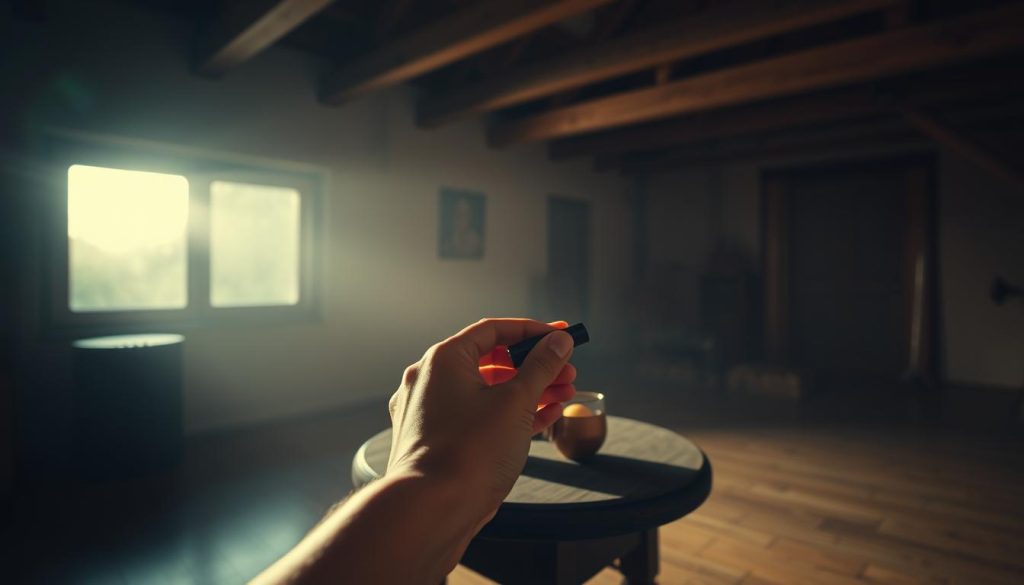
Metronome practice from 60 to 80 BPM, in stages
Suggested routine: 5 minutes at 60 BPM, 5 minutes at 72 BPM, then 5 minutes at 80 BPM.
Practise quarter notes and eighth notes to establish the beat before increasing the speed.
Rhythmic patterns and timed sequences
Introduce two simple patterns: eighth note–eighth note–quarter note, and dotted quarter note–eighth note. Repeat them in a loop.
Build an exercise sequence: 2 minutes of silently fingering the beat, 3 minutes with breath and simple attacks, then 3 minutes on a short phrase.
- Use sheet music or tablature with simple symbols to visualise note lengths.
- Vary the exercise: start with an audible metronome, then silence every other beat to test your independence.
- Record 30 seconds and compare your playing with the click to correct notes that come early or late.
| Goal | Duration | Action |
|---|---|---|
| Steady the beat | 5 minutes | Quarter notes and eighth notes with a metronome, from 60 to 80 BPM |
| Make attacks automatic | 3 minutes | Repeated fingering patterns |
| Control dynamics | 4 minutes | Crescendo and decrescendo over 4 measures without losing the beat |
Practise in front of a mirror or record yourself to assess your steadiness. Hearing the music internally and maintaining airflow help keep notes clear.
Note: this progressive method helps you play the ocarina in time and track your progress.
Fingerings, scales and pitch: playing simple melodies
Mastering fingerings turns a sequence of notes into a clear melody.
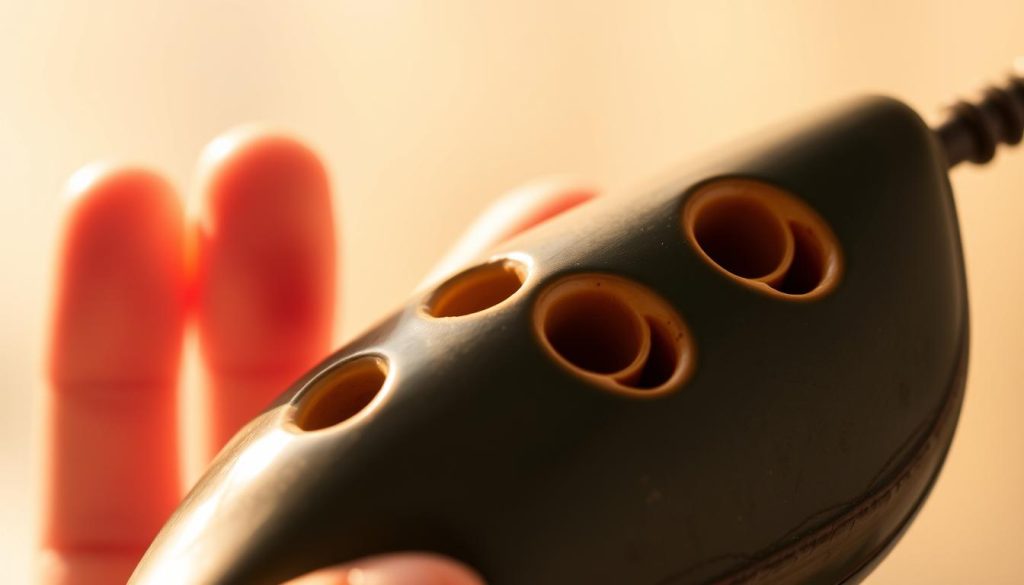
Differences between 4-, 6- and 12-hole models: 12-hole transverse ocarinas offer a wide range of notes. Four- and six-hole pendants are compact and suitable for smaller hands.
Four-, six- and 12-hole ocarinas: precise finger placement
Cover each hole completely with the pad of your finger, without stretching your fingers. Keep them close to the holes for quiet transitions.
Fingerings are often standardised, but check the STL or OcarinaTabs.org charts for your model.
The C major scale, step by step
Practise the scale with a metronome at 60 BPM. Ascend and descend slowly, checking each note with a tuner.
Adjust the airflow to the pitch: the high register requires less air and more control.
Ascending, descending and octave jumps
Practise ascending in thirds and playing four-note patterns to strengthen coordination.
Practise octave jumps: play a low note, then its octave, aiming to keep the same tone quality.
- Play short, simple melodies based on the scale to connect technique with musical expression.
- Choose a model that suits your hand size and musical goals.
| Goal | Action | Duration |
|---|---|---|
| C major scale | Metronome at 60 BPM and tuner | 4 min |
| Octave jumps | Low note, then its octave, with the same tone quality | 3 min |
| Simple melody | Four-note phrase, controlled fingering | 3 min |
Tip: use reliable tablature and keep notes on the breath pressure needed for each pitch.
Tools and methods for faster progress
Simple, well-chosen tools speed up learning.
Apps: use an electronic tuner or smartphone app to check pitch in real time. A digital metronome steadies the beat and provides immediate numerical feedback.
Guided practice, sheet music and recordings
Look for sheet music and tablature organised by level on OcarinaTabs.org or STL, so you can start playing melodies without uncertainty about the fingerings.
Record yourself once a week to assess sound quality and intonation. Keep the files and note your improvements.
| Tool | Use | Frequency |
|---|---|---|
| Tuner or app | Pitch accuracy | Every session |
| Reliable sheet music | Progressive repertoire | Weekly selection |
| Recordings | Assessment | Once a week |
Choosing an instrument: plastic models are durable and affordable; ceramic offers a warmer tone. Choose according to your budget and how you intend to play.
- Keep a practice log with a daily entry: spend 15 focused minutes on pitch, articulation, tempo and repertoire.
- Work toward specific goals: use short sets to address a weakness, then bring that skill back into a musical phrase.
- Join communities and consult sheet music libraries to vary the pieces you play.
“Fifteen structured minutes are better than an unfocused hour.”
Sample schedule: 5 days of short sessions, 1 day reviewing recordings and 1 day of rest. Always check the condition of your ocarinas and accessories, such as the case and cloth, to preserve their quality.
Avoiding common beginner mistakes
Learning to identify common problems prevents months of ineffective practice.
Blowing too hard, air leaks at the holes and embouchure
Recognising excessive breath pressure: if high notes sound shrill or out of tune, reduce the airflow. Check the note with a tuner to find the right pitch.
To prevent air leaks at the holes, place your finger pads securely and avoid large movements that cause clicking. Practise lifting and lowering your fingers close to the holes.
If you tighten your lips too much around the mouthpiece, you may hear whistling. Relax them and aim for a gentle seal without squeezing the instrument.
Uneven breathing, posture and coordination
Slouching restricts breathing. Lengthen your spine to free the airflow and reduce fatigue. A stable position helps you play consistently.
Adopt a simple routine: use the candle exercise to steady your breath, a tuner to check pitch and short recordings to track progress.
- Spot excessive breath pressure: if high notes are too forceful, control the airflow.
- Check the holes: cover them with your finger pads and use small finger movements.
- Relax your lips around the mouthpiece: keep them supple to prevent whistling.
- Correct your posture: stand tall to improve endurance.
- Keep a log: note air leaks and unclear attacks so you can target your practice.
“A simple, consistent routine corrects most pitch problems within a few weeks.”
| Problem | Remedy | Tool |
|---|---|---|
| Blowing too hard | Reduce airflow and check with a tuner | Tuner |
| Air leaks at the holes | Place finger pads firmly; use small movements | Mirror |
| Tight embouchure | Relaxed lips and a gentle seal | Candle |
Choosing and caring for an ocarina: everyday sound quality
Your choice of instrument affects every detail of the sound you produce each day.
Plastic or ceramic, transverse or pendant models
Ceramic models have a warm tone but are fragile.
Plastic models are durable and affordable, although they retain more condensation.
Choose a transverse model for versatility and a wider range of notes. Choose a pendant if you want a compact instrument with four or six holes.
Cleaning, condensation and storage
After each session, wipe the instrument with a soft cloth. Blot condensation from a plastic model; let a ceramic model dry naturally.
Store the ocarina in a hard case, away from sunlight and moisture. Never immerse it.
- Assess a model by the comfort of its holes and its response in the high register.
- Check its tuning: consider STL or Hindocarina if you want to follow standard sheet music.
- Weekly tip: inspect the holes, blow briefly to clear dust and check the tuning.
| Goal | Action | Result |
|---|---|---|
| Travel | Durable plastic model | Less risk of damage |
| Performance | Well-made ceramic model | Better sound quality |
| Accurate pitch | Check with a tuner | Sheet music you can play accurately |
“A sturdy practice model for travel, a performance model for tone.”
Conclusion
Conclusion
A short, regular plan helps you master the basics. Working on posture, embouchure and abdominal breathing improves breath control and precision. Ten to fifteen minutes a day is enough to establish the movements.
Use a tuner, consult reliable sheet music and practise the C major scale every other week. Choose suitable models: a sturdy plastic instrument for travel and a ceramic one for its tone on stage.
Care for the instrument to keep each note stable and transitions between fingerings clean. Explore simple melodies, then varied pieces, alternating between reading music and playing by ear.
Practical plan: 5 minutes of breathing, 5 minutes of scales and fingerings, then 5 minutes of melodies. This structured practice helps you progress quickly on the ocarina.