
Objective: introduce the subject and explain, step by step, why this instrument appeals to musicians today.
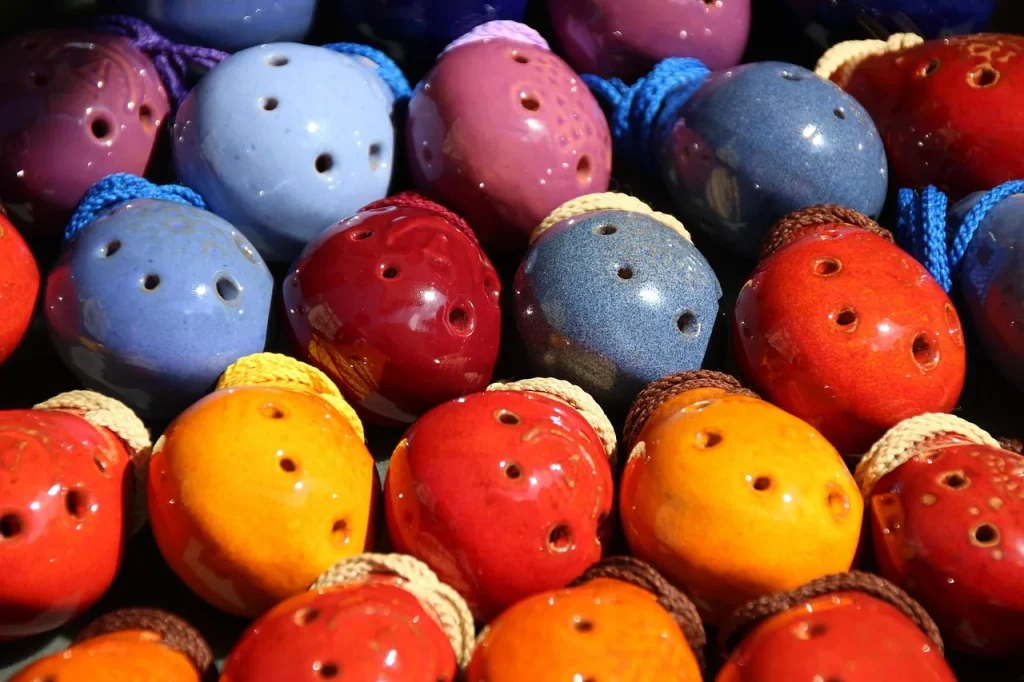
The ocarina is a vessel flute, a small, egg-shaped wind instrument. Its outline resembles a little goose, which explains its name, derived from the Bolognese dialect.
It is classified as a woodwind because of the way it produces sound: air splits against an edge and resonates inside a cavity. This enclosed shape has a strong effect on its tone.
The player changes the pitch by covering or uncovering holes with their fingers while blowing into a mouthpiece. Models range from traditional terracotta to modern plastic.
In this article, we will look at how the ocarina differs from the recorder, how its acoustics work, its ranges, history and types. To learn more about the instrument’s origins and history, read this dedicated article.
A simple definition of the ocarina: vessel flute, wind instrument and key features
Its rounded shape conceals a simple acoustic principle: an air channel and a resonating cavity.
Classified among duct vessel flutes, this wind instrument is played by blowing into a mouthpiece fitted with an edge. An internal whistle sets the air vibrating.
Its egg-shaped form creates an enclosed inner chamber. Only the mouthpiece and finger holes open to the outside. This geometry differs from that of a recorder or transverse flute, whose tube governs the air column.
Shape, mouthpiece and holes
The beak is built into the air channel; it cannot be removed. Opening or closing a hole changes the resonant frequency.
Common models have 4, 6, 8, 10 or 12 holes. The number of holes affects the range, fingerings and ease of playing in tune.
Helmholtz resonator
The acoustic principle is that of a Helmholtz resonator: the cavity works like a bottle that you blow across.
The fundamental frequency depends on the chamber’s volume and openings. The result is pure notes, a consistent tone and fewer unwanted harmonics than tubular flutes produce.
| Feature | Effect | Examples |
|---|---|---|
| Enclosed shape | Consistent tone | Egg-shaped body, fixed volume |
| Duct mouthpiece | Quick response to breath | Internal whistle, built-in beak |
| Number of holes | Range and fingerings | 4, 6, 8, 10, 12 |
| Helmholtz resonator | Pure notes, few harmonics | Analogy: blowing across a bottle |
What is an ocarina? A simple definition and its uses
Compact and versatile, this wind instrument appeals to beginners and experienced musicians alike.
Uses: it serves for introductory music lessons, ear training, expressive melodies and ensemble accompaniment.
It is accessible and quick to pick up. Players learn simple fingerings and breath control. Its compact shape makes it easy to carry and play wherever they go.
Ranges, keys and volume
There are four families: soprano (high), alto (middle), tenor (low to middle) and bass (low). Models tuned in C, F or G major make ensemble playing easier.
During normal playing, the average volume is around 70 dB, a moderate level suitable for practicing at home.
“A gentle, rounded, sometimes melancholy tone: its character depends on the material, size and breath.”
- Progression: nursery rhymes → popular tunes → contemporary pieces.
- Recommended beginner model: a 12-hole alto, for its useful range and reliable intonation.

| Aspect | Benefit | Typical use | Note |
|---|---|---|---|
| Range | Variety of registers | Soprano, alto, tenor, bass | Choose according to playing comfort and size |
| Keys | Easier reading | C, F and G major | Ensemble playing |
| Volume | Moderate level | About 70 dB during normal playing | Suitable for practicing at home |
| Beginner models | Comfort and range | 12-hole alto | A good balance for developing players |
Origins and history: from prehistory to Giuseppe Donati and then Takashi Aketagawa
From the musical pottery of ancient civilizations to Italian and Japanese workshops, the instrument’s evolution reveals a remarkable continuity.
Clay vessel flutes appeared very early in Mesoamerica and the Andes. The Maya, Aztecs and Incas made instruments for rituals and everyday use. These surviving objects show how widely the tradition spread.
Early Mesoamerican and Andean forms
Archaeological finds include ritual objects and sounding figurines. Examples from Runik, Kosovo, and other European sites also confirm an ancient presence on that continent.
Etymology and growth in Italy
The word comes from the Bolognese dialect and means “little goose,” alluding to the instrument’s shape. In Budrio in 1853, Giuseppe Donati standardized the ten-hole model, transforming a toy into a recognized wind instrument.
Modern standardization and the 20th and 21st centuries
In 1928, Takashi Aketagawa developed the twelve-hole version, improving its range and ergonomics. The Helmholtz resonator and the nature of the vessel flute remain central to the design despite changes in materials.
- Spread: Italy → Japan → China, United States.
- Recent history: military use, decline, then a revival driven by media and video games.
- Standard models: 10 holes, then 12 holes for more consistent playing.
For an overview of the instrument’s origins, construction and playing techniques, read this companion article: the instrument’s history and playing techniques.
Ocarina types and models: from pendant to transverse, single, double, triple or quadruple
Models vary widely, from discreet pendants to instruments designed for virtuoso playing. The main families differ in shape, number of holes and how they are held.
Shapes: pendants include compact versions (the six-hole English model and eight-hole Peruvian model). Transverse models are held horizontally and often have 10 or 12 holes. Inline models have aligned holes and are easy to carry.
Basic configurations
Six holes (English): ideal for beginners, with a range limited to one octave and excellent portability.
Eight holes (Peruvian): a wider range, with about 11 usable notes.
Ten holes (inline): simpler fingerings and an extended range for a richer repertoire.
Twelve holes, the classic model: a modern standard with consistent fingerings, offering up to two octaves and great versatility on stage.
Multiple chambers and innovations
Double, triple and quadruple instruments combine several chambers or mouthpieces. The double (Italy) offers about 17 notes, the triple (Japan) about 21 and the quadruple (China, 2007–2009) about 24. These designs extend the range and allow quick transitions.
- Fingerings: pitch rises as holes are opened; precise finger movements are needed to play in tune.
- Comparison: the grip resembles that of a recorder, but the geometry and response differ; the twelve-hole model remains the best compromise.
- Unusual designs: keyed models have existed since the late 19th century but remain rare.
Materials and construction: terracotta, ceramic, wood, plastic, metal… and their effect on tone
The material affects tonal color: clay, wood, plastic and metal produce distinct sounds.
Overview of materials: terracotta and porcelain remain traditional choices. Wood adds organic warmth. Plastic is durable and inexpensive. Metal is rare but projects strongly. Handmade pieces can also be found in bone, stone, bamboo, seeds or fruit shells.

Effect on sound: ceramic gives a precise, rounded tone. Wood sounds more “alive” but is affected by moisture. Plastic sounds drier. Metal affects projection. Size and shape remain decisive: an ocarina about 15 cm long will have a different range from a pendant.
Construction matters as much as material. The mouthpiece, internal whistle, uniformity of the holes and precision of the cavity determine tuning and tonal stability.
| Material | Sound characteristic | Recommended use |
|---|---|---|
| Terracotta / ceramic | Rounded, precise sound | Beginners and concerts |
| Wood | Warm, responsive sound | Soloists seeking a particular tonal color |
| Plastic | Dry sound, durable material | Playing on the go, schools |
| Metal & other materials | Strong projection, unusual tone | Experimentation and new works |
Comfort and care: weight, grip and slipperiness vary by material. Clay and ceramic need protection from knocks. Wood must be protected from moisture. Clean the mouthpiece regularly to preserve its precision.
The choice of material is primarily musical: when the instrument is well made, the material supports the desired tonal color and projection.
Sound, repertoire and uses: from classical music to popular culture
Its distinctive tone has crossed genres, from the concert hall to popular soundtracks. This flute has a gentle palette capable of melancholy or lively expression.
Classical music: Janáček used it in Říkadla (1927) to evoke childhood. Later, Ligeti used four ocarinas in his Violin Concerto (1990–1993) and in Sippal, dobbal, nadihegedűvel (2000). These uses reflect the 20th-century search for new timbres.

Contemporary ensembles explore textures and subtle polyphony, along with the instrument’s teaching potential. Many musicians, YouTubers and specialist groups keep it alive on stage.
- Sound palette: sustained notes, singing legato, pure resonance.
- Uses: concerts, composition, teaching and soundtracks.
- Variety of models: from 6 to 12 holes, as well as multiple-chamber models for a wider repertoire.
Popular culture brought the instrument to wider attention through the success of The Legend of Zelda (Ocarina of Time, Majora’s Mask). Films, anime (Totoro, Naruto, Captain Harlock) and composers such as Morricone have strengthened its place in the popular imagination.
“Its enclosed shape favors a continuous melodic line, ideal for cinematic atmospheres.”
From Giuseppe Donati to the model modernized by Takashi Aketagawa, historical continuity provides a foundation for innovation. To learn more about models and buying one, read our practical guide.
Choosing an ocarina and getting started in France: models, comfort, budget and first steps
The right choice depends on range, comfort and mouthpiece quality.
Recommended model: start with a twelve-hole alto tuned in C, F or G. It offers a useful range, consistent fingerings and a straightforward path for improvement.
Materials: terracotta or ceramic offer an appealing rounded tone. Plastic is durable and affordable. Wood offers a rich tonal color but needs more care. Metal is rare and reserved for particular uses.

Budget, tuning and comfort
Expect to spend about €40–€100 on a first instrument. For stage use or recording, budget €100–€300. Beware of very cheap copies that do not play in tune.
Test how it feels in your hands: hole spacing, hole diameter and instrument weight affect finger accuracy. Check the tuning by holding long notes while using a tuner.
“Try the instrument before choosing it: doing so helps avoid disappointment and makes learning easier.”
Practical first steps
- Stand or sit upright and blow steadily.
- Practice connecting neighboring notes and keeping their pitch steady.
- Ask instrument makers, specialist shops and communities in France for advice and after-sales support.
| Criterion | Recommendation | Why |
|---|---|---|
| Number of holes | 12 holes (alto) | Useful range and consistent fingerings |
| Common keys | C / F / G | Compatible with sheet music and ensemble playing |
| Budget | €40–€100 (beginner), €100–€300 (professional) | Quality, tuning and finish |
| Material | Terracotta / plastic / wood | Rounded tone, durability or tonal color |
Conclusion
Its distinctive sound is recognizable from the first note. strong.
In summary, the ocarina is an egg-shaped vessel flute: a wind instrument with a mouthpiece and finger holes. This article has explained how it produces notes, introduced its main families and traced its history from the Italian “little goose” to Asian workshops.
When choosing one, consider its shape, number of holes and tuning. Regular practice, breath control and careful listening will help you improve quickly.
After years of renewed media attention, the ocarina is regarded as an accessible melodic instrument. Keep exploring by trying different models, reading sheet music and listening to recordings: nothing replaces playing it yourself.