
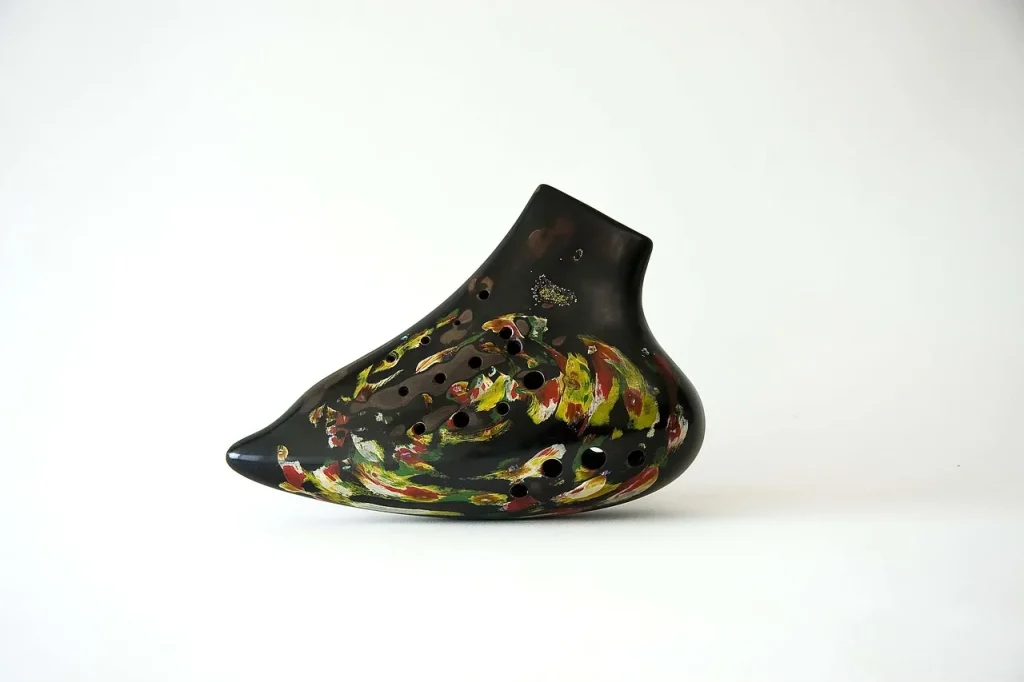
Quick introduction: this guide compares two popular types of vessel flute with a windway. Transverse ocarinas, often called “sweet potatoes,” and pendant ocarinas differ in size, number of holes, and use.
Sound depends mainly on the chamber’s internal volume and the area of the open holes, more than on its shape alone. A single-chamber instrument spans 1 to 1.6 octaves; multichamber versions offer 2 to 3 octaves.
The transverse ocarina (10 to 12 holes) remains the standard choice for learning and playing a wider repertoire. The compact pendant (4 to 6 holes) favors portability and simple melodies in a higher register.
What you will find in this guide: selection criteria (range, tuning, volume, ergonomics), the influence of materials (ceramic, plastic, wood, metal), examples of models, and ways to use them at home, while traveling, or on stage.
Our aim is to give you a clear overview of ocarina types, their advantages, and their limitations, so you can choose according to your skill level, budget, and the music you want to play.
Buying considerations in France today
In 2024, buying decisions in France often came down to three factors: skill level, intended repertoire, and budget.
Buyers range from people drawn in by popular culture to musicians seeking an easy-to-carry secondary instrument. Beginners favor simple, affordable models. Experienced players look for more demanding and precise instruments.
Materials and budget: plastic costs about a third as much as ceramic and withstands drops better. This makes it an excellent choice for children, travel, and trying the instrument without a large financial commitment.
- Consider the repertoire: simple tunes or full arrangements.
- Include accessories (case, instruction book, metronome) in your overall budget.
- Check availability in France through specialist online retailers (Thomann) or established brands (Focalink, Deekec, Night by Noble).
Practical tip: read reviews from France or try the instrument in a shop to assess its ergonomics and sound projection. Start with a simple model, then upgrade as your skills and musical ambitions grow.
Definitions and shapes of the two ocarina types
The two main types differ in silhouette, grip, and number of holes.
The transverse model has an elongated body and a perpendicular mouthpiece. Its holes are arranged for both hands, allowing a complete, mostly linear fingering pattern. The modern standard model often has 10 to 12 holes; the 12-hole version became established after 1928 thanks to Takashi Aketagawa.

The other type is minimalist: it has 4 to 6 holes and hangs around the neck on a cord. Invented by John Taylor in the 1960s, it puts portability first. Its small chamber produces a high register suited to simple melodies.
Different shapes (oval, round, or animal-shaped) mainly affect ergonomics and appearance. By contrast, sound depends above all on internal volume and the area of the holes. Multichamber designs are common among transverse ocarinas but rare among pendants.
- Use: transverse ocarinas for a broad repertoire and stage performance.
- Portability: pendants for travel, teaching, and spontaneous playing.
Transverse or pendant ocarina: what are the differences?
Range depends chiefly on the chamber and the number of holes. In general, a single chamber spans about 1 to 1.6 octaves. Multichamber instruments can reach 2 to 3 octaves, which is useful for a wider repertoire.
Available musical range
Small models produce high notes and need less breath. Large ones sound lower and require more air.
Sound quality, volume, and tuning
Sound quality varies: larger models project more effectively and maintain steadier intonation. Compact versions have a charming tone but limited projection.
Ergonomics, balance, and grip
Physical balance varies by type. Models designed for both hands provide steady support. Pendants are very light and easy to handle with one hand.
Learning curve and playing experience
As for the playing experience, 4- to 6-hole instruments are quick to learn. Those with 10 to 12 holes take more practice but provide access to a wider range and chromatic notes.
- Choosing tip: favor a model with stable intonation if you plan to play in an ensemble.
- Materials: ceramic reduces condensation; plastic may produce more of it.
| Criterion | Compact type | 10- to 12-hole type | Note |
|---|---|---|---|
| Range | About 10 high notes | About 1 to 1.6 octaves (or more with multiple chambers) | Multiple chambers provide more octaves |
| Sound quality | Charming tone, limited projection | Stable intonation, greater volume | Finish and material make a difference |
| Learning | Quick (a few hours) | Takes longer, more versatile | Depends on your musical goal |
| Ergonomics | Very light, one point of support | Balanced between both hands | Comfort depends on hand size |
Number of holes, chambers, and note range
The internal design, especially the holes and chambers, determines the playable range and available chromatic notes.
Number of holes: 4- to 6-hole models provide the essential scale degrees and are very quick to learn. They suit simple tunes and short improvisations.
Models with 10 to 12 holes allow a full set of fingerings. They make chromatic notes, smooth transitions, and a richer musical vocabulary easier to achieve.

Single or multiple chambers
A single chamber spans about 1 to 1.6 octaves. Blowing harder can extend the range slightly, but it remains limited.
Multichamber systems (usually two or three chambers) extend the range, create drones, or allow harmonies. The CODA EDC illustrates the principle with two compact chambers that can be played separately or together.
Registers and uses
Small models: soprano, for lively tunes. Medium models: alto, for versatility. Large models: tenor or bass, with a warmer sound but a greater need for air.
| Feature | Compact 4- to 6-hole type | 10- to 12-hole or multichamber type | Note |
|---|---|---|---|
| Register | Soprano or high | Alto to bass, depending on size | Size has more influence than the number of holes |
| Chromatic notes | Limited, using cross-fingerings | Complete, stable chromatic notes | Favor 12 holes for a wider repertoire |
| Use | Practice, teaching, travel | Stage, recording, wider repertoire | Two chambers offer versatility without changing instruments |
Tip: check the manufacturer’s range in scientific pitch notation (SPN) instead of relying only on labels. Hole placement varies by design; the number of holes alone does not guarantee easy access to notes.
Ergonomics, breath, and the balance between comfort and performance
Grip and hole placement often determine playing comfort more than material does. Ideal spacing of 15 to 18 mm makes natural finger placement easier and reduces strain.

Hole placement and accessibility
Choose hole diameters you can cover completely without straining. Test access to the upper holes and see whether the instrument’s curve suits your hand.
Models for left-handed players reverse the hole layout; consider one if the standard layout feels uncomfortable.
Breath control and balance
High-pitched instruments need little breath, while lower-pitched ones require a steady, controlled airflow. A mouthpiece that is too wide increases the effort needed to play.
The balance between weight and stability affects note attacks and sustain: plastic suits long sessions, while ceramic favors projection and stability.
| Criterion | Practical effect | Advice |
|---|---|---|
| Hole spacing | 15 to 18 mm: comfort | Test before buying |
| Mouthpiece | Wide: more effort | Match it to your breathing capacity |
| Material | Plastic: light; ceramic: stable | Plastic for portability, ceramic for the stage |
| Type and fatigue | Transverse: better weight distribution | Try a larger model to assess its balance |
Final tip: look for careful finishing and cleanly drilled holes to avoid air leaks. Practice breathing exercises (including diaphragm exercises) to improve intonation and stamina.
Materials and sound quality: ceramic, plastic, wood, metal
The material you choose shapes the tone and affects everyday use.
Ceramic: this traditional material offers a warm tone rich in harmonics. Its porosity limits condensation in the windway, while the glaze protects the surface. Fragile if dropped, it can last more than 10 years with careful handling.
Plastic: durable and inexpensive, it suits travel and teaching. Its tone is more neutral but still acceptable. Watch for condensation, which is more pronounced than with ceramic. Its service life is about 5 years with intensive use.
Wood and metal: special cases
Wood: its velvety tone is appealing. It needs oiling and humidity control (40 to 60%) to prevent cracks and changes in tuning.
Metal: very strong but expensive. Condensation builds up on it as it does on plastic, limiting its popularity.
| Material | Tone | Durability | Recommended use |
|---|---|---|---|
| Ceramic | Warm, rich | More than 10 years (with care) | Stage, recording |
| Plastic | Neutral, adequate | About 5 years (intensive use) | Travel, learning |
| Wood | Velvety, warm | Varies (with care) | Appearance, intimate playing |
| Metal | Clear, precise | Very high (expensive) | Rare uses, collections |
Tip: the finish of the labium and the precision of the holes matter as much as the materials for sound quality. For a multichamber instrument, also explore specialist information, such as this guide to the double-chamber ocarina.
Suitable repertoire, sheet music, and musical styles
Before learning a piece, check whether its notes fit the model’s stated range. Compare the notes in the score with the manufacturer’s specified range to avoid notes your instrument cannot play.

A 12-hole transverse ocarina covers most short to medium-length melodies and makes chromatic notes easier. Multichamber models offer 2 to 3 octaves for more complex arrangements and harmonic effects.
The small neck-worn model suits nursery rhymes, simple pop tunes, and high-pitched video game themes. The alto is the most versatile: it suits about 80% of common pieces for ensembles and accompaniment.
- How to read a specification: identify the lowest and highest notes, then compare them with your instrument’s range.
- Repertoire examples: nursery rhymes and pop tunes for small models; folk, chamber music, and pop covers for the 12-hole model.
- In practice: transpose if necessary, use a metronome and backing tracks, and choose dedicated sheet-music collections to make progress.
One last point: intonation and articulation make melodies expressive. Beyond the number of available notes, work on precision.
Skill levels: beginners, intermediate players, experts
To make progress, match the instrument type to your technical ability. This choice affects motivation, learning speed, and the repertoire you can play.
Beginners
Beginners benefit from a 4- to 6-hole model. These types can be learned in a few hours.
Schools often recommend 6-hole models for better finger balance.
Intermediate players
After a few months of practice, switching to a 12-hole model expands your range and access to chromatic notes.
Ceramic becomes appealing at this stage for its tone and stability. Lessons (about €30 a month) can speed up progress.
Experts
Expert players benefit from two- or three-chamber models, which provide 2 to 3 octaves and allow harmonic effects.
These instruments cost about 40% more but open up possibilities for polyphony and professional recording.
- Guide beginners toward 4- to 6-hole models for a short, motivating learning experience.
- At the intermediate level, favor 12-hole models for working on scales, chromatic notes, and dynamics.
- For experts, recommend two or more chambers to extend the range and add complexity to articulation.
- Follow a learning plan over several months, with clear milestones, and assess your level regularly.
- Musicians who play other wind instruments often advance more quickly in breath control.
- Regular practice and critical listening matter more than choosing the most expensive model.
Final tip: define your musical needs before each new purchase so you can make a focused, lasting choice.
Budget, models, and makers: from practical choices to premium instruments
Your budget often determines the balance between durability, tone, and quality of workmanship. First decide how you intend to use the instrument: for learning, performance, or collecting. This will guide the type of model and how much to invest.
Entry-level plastic models for learning
Plastic models generally cost between €20 and €50. They are light, withstand drops, and are easy to maintain.
That makes them a sensible first purchase, especially for children and travel. Night by Noble is known for its ergonomic plastic models.
Quality ceramic: balancing price and tone
Ceramic models usually cost between €50 and €150. They offer richer quality of tone and more stable intonation.
Focalink is known for its double models and their precision. Bear in mind that ceramic is more fragile and needs more careful handling.
Examples of popular makers and models in France
Makers represented in the French market include Focalink, Night by Noble, and Deekec.
European retailers such as Thomann make buying easier and provide access to local after-sales service.
- Typical starter bundle: instrument + case + instruction book + metronome = complete beginner’s equipment.
- Budget by category: plastic, €20 to €50; ceramic, €50 to €150; handcrafted or luxury, more than €150.
- Consider a secondhand instrument to upgrade at a lower cost.
Before completing your purchase: check the tuning (A440), stated range, and finish of the labium. Ask about the seller’s warranty and return policy.
Finally, allow for a learning budget (lessons, instruction books): this investment will help you get the most from your chosen model. For a practical comparison, examine two shop listings and test how the instruments feel in your hands before buying.
Ways to use an ocarina: choosing according to your needs
To decide, start by defining where and how you will play most often.
Travel, occasional playing, and teaching children
Mini format: the 4- to 6-hole pendant (about 150 g) is ideal for traveling light.
Made of plastic, it is sturdy, can be worn around the neck, and encourages spontaneous playing.
For children, this model is simpler: it places fewer demands on their fingers and gives them a quick sense of achievement.
Richer melodies, recording, and stage performance
For a broader repertoire, choose a 12-hole ceramic transverse ocarina.
Ceramic provides a stable tone, better projection, and precise intonation for recording.
On stage, consider a microphone and a backup instrument; multichamber models add 2 to 3 octaves that professional musicians can put to use.
“Choose the balance of comfortable handling and sound requirements that suits your playing sessions.”
- Recommended set: a 12-hole alto and a small secondary model.
- Before each outing: check the tuning, make sure the holes seal properly and the mouthpiece is clean, and prepare the case.
| Situation | Recommended type | Main advantage |
|---|---|---|
| Travel or walks | 4 to 6 holes (plastic) | Light, sturdy, immediately playable |
| Teaching children | 4 to 6 holes | Simple fingerings, quick motivation |
| Stage or recording | 12 holes (ceramic) or multichamber | Stable tone, projection, and extended range |
Conclusion
In short, size, the number of holes, and the number of chambers determine the range and the notes you can play.
A transverse ocarina (10 to 12 holes) offers versatility and accurate intonation for a broader selection of melodies and arrangements. A pendant (4 to 6 holes) favors portability and an easy introduction to playing.
Ergonomics (15 to 18 mm hole spacing) and materials affect sound quality, condensation, and durability. Choose an instrument that fits your skill level, repertoire, and practical needs as a musician.
Check the range in scientific pitch notation (SPN), compare specifications (hole number and placement vary by model), and try several models to find the right balance. Set a practice routine and let the music guide your experience.