
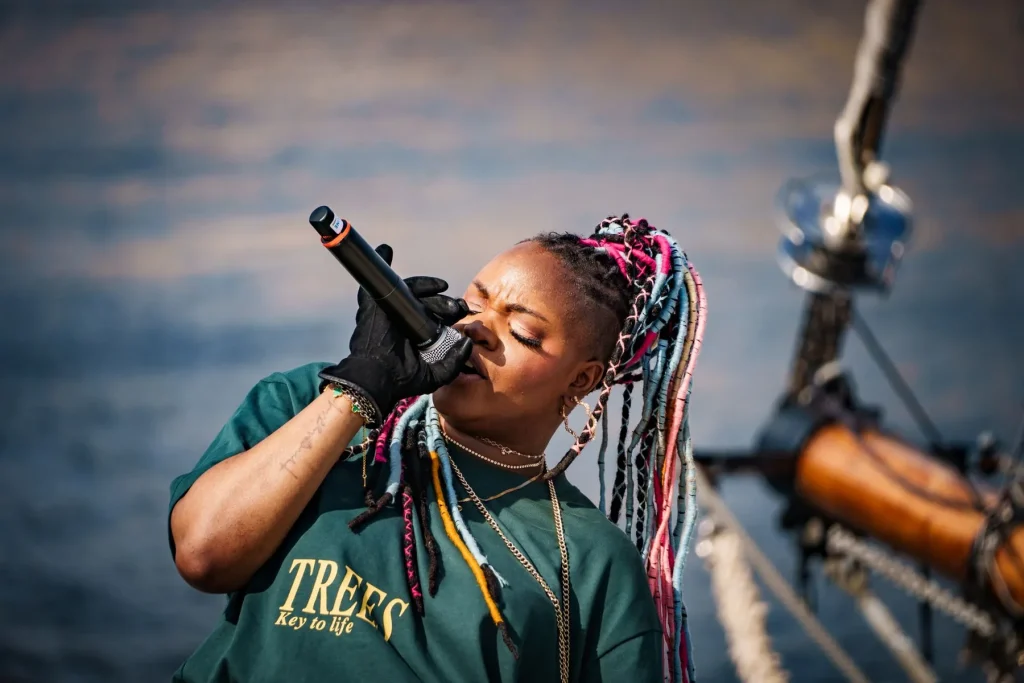
Theatre and French chanson have always shared a stage: the stage of human emotion. From Piaf to Barbara, from Brel to Fishbach, many artists have drawn on acting to enrich their vocal performances. Today, a new generation of songwriters and performers is breathing life into this meeting of words and movement, where the voice becomes both an instrument and a character.
The body as an instrument: when actors inspire singers
On stage, the voice alone is not enough: the whole body sings. Artists with a theatre background understand this well: before making a sound, they must inhabit a space, breathe and feel. This awareness of the body turns a vocal performance into a fully embodied one. Every gesture, glance and silence becomes part of the song.
More and more French performers are embracing this approach to the stage. They do more than move from one song to the next: they tell stories, build scenes and perform like actors. This is the path taken by Claire Kmy, a singer-songwriter and actor trained in choral conducting and drama. Her work combines the musical discipline she gained at the conservatoire with the emotional intensity of acting to create singing that feels alive, fluid and almost cinematic.
That dual training reminds us that the voice is more than an instrument: it is an extension of the body, the mind and the breath. The singer becomes a storyteller in the flesh, as much a stage performer as a musician.
Speak before singing: the power of words in performance
In French chanson, words often come before music. There is a reason for this: many great singers are also remarkable storytellers. As in theatre, everything begins with intention. The way a performer pronounces a syllable, leaves a pause or stretches a vowel can turn an unremarkable song into a source of pure emotion.
Singers who come from theatre learn to “speak” before they sing. They know that meaning comes through breathing, nuance and the tension between breath and speech. This precision gives their performances rare depth, as the voice becomes language and the song becomes a space for dramatic expression.
Many young artists today share this physical connection to the words and seek more than vocal display. They look for truth in a word, balance in a phrase and honesty in an emotion. In this way, French chanson returns to its original role: an art of words set to music, where every line carries a story to be lived and felt.
From the stage to stagecraft: towards a more embodied song
More and more singers conceive their concerts as full-fledged shows. Instead of simply moving through a setlist, they imagine visual worlds, movements and moments to breathe — in short, complete staging. The concert then becomes an extension of theatre: a narrative space where each song is an act and each silence a transition.
This approach changes the relationship with the audience. People experience more than a melody: they feel a story in their bodies. Lighting, gestures and set design all contribute to this musical drama. It echoes an art form that draws on both lyric-driven chanson and contemporary theatre.
This movement marks a return to embodied performance. Singing becomes more than “performing a piece”: it means inhabiting a stage and offering something of oneself through words and breath. Where these arts meet, French chanson rediscovers its essence: a living story carried by artists who act as much as they sing.
A living bridge between the spoken arts
Between theatre and French chanson, there is no longer a boundary, but a shared breath. Both arts draw from the same source: the voice as a vehicle for emotion, meaning and presence. Every performer who follows this path reminds us that singing is, above all, storytelling — and that a successful song is never far from a well-acted scene.
In this subtle blend of words and movement, a new generation of artists continues to explore the ground shared by music and theatre. Their deeply human art invites us to listen differently: not only with our ears, but with our whole bodies.