
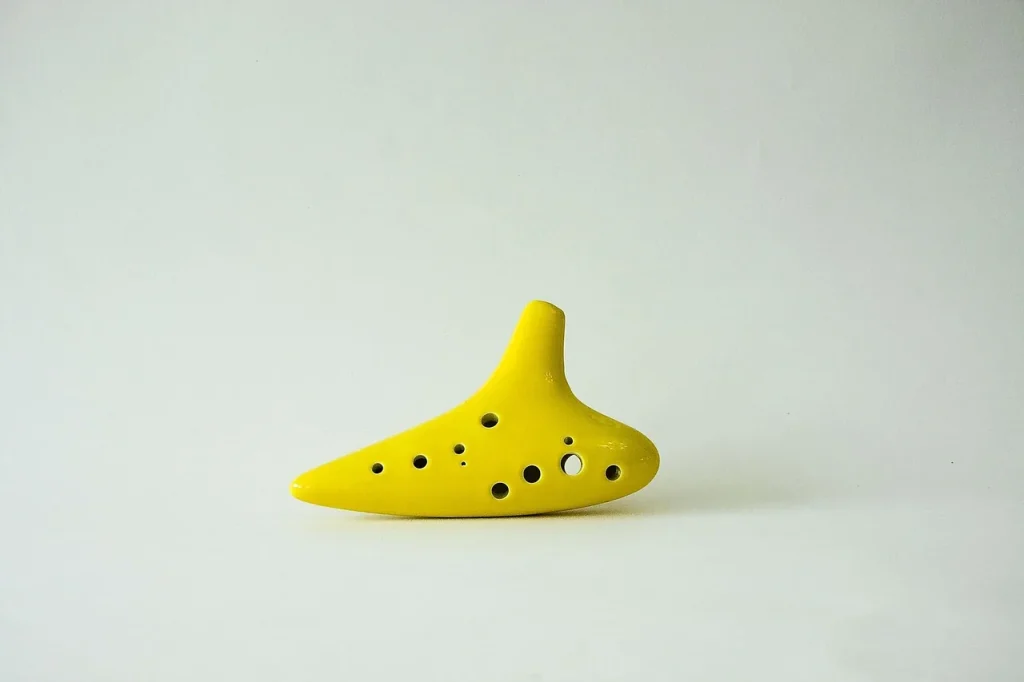
The ocarina is a vessel flute with a soft, melodic tone. It stands at the crossroads of several cultures and spans millennia. Its history begins with earthen instruments and continues around the world.
Ancient evidence points to the use of ceramic instruments and animal-shaped forms in rituals. Finds include Neolithic artifacts, Asian xun and Mesoamerican terracotta models.
In the 19th century, standardization in Italy established the ten-hole model. The 20th century then brought twelve-hole and multiple-chamber versions. Its contemporary popularity also owes much to popular culture, particularly video games, which renewed interest worldwide.
Ceramic remains a standard material, although plastic, wooden and metal models also exist. To learn more about the differences between instruments, see this article on the ocarina and pan flute.
Why this wind instrument still fascinates us today
Few instruments offer such a direct connection between breath and musical expression. The tone is soft, the notes come easily, and their purity is moving.
Quick to learn: a few holes to master, a natural mouthpiece and intuitive breath control. That helps beginners and musicians make rapid progress.
The price remains accessible, at roughly €20 to €150 depending on the material. Plastic models appeal to children because they are sturdy, while ceramic offers the rich tone sought by performers.
Popularity surged again after 1998 with Zelda, supported by online tutorials and videos. Communities share sheet music, advice and repertoire, sustaining interest over time.
- Portable and compact
- Easy to maintain
- A variety of models and ranges: from soprano to tenor
| Advantage | Audience | Approximate price |
|---|---|---|
| Durability (plastic) | Children, beginners | €20–40 |
| Rich tone (ceramic) | Performers, discerning enthusiasts | €60–150 |
| Portability | All levels | Varies |
Distant origins: from the earliest archaeological traces to Andean rituals
The discovery at Runik confirms an ancient musical practice in Europe: a Neolithic ocarina dated to approximately 8,000 years ago illustrates a deep musical tradition.
In Mesoamerica, the Aztecs, Maya and Chibcha made earthen and ceramic instruments.
These pieces, often shaped like animals, appear in religious and funerary rites.
The murals of Bonampak show musicians in a ceremonial setting.
In Asia, the Chinese xun, around 7,000 years old, likewise relies on the acoustic principle of a resonant cavity.
In Africa, vessel whistles attest to similar practices.
These discoveries reveal varied forms: egg-shaped and figurative, with either many or few holes.
- Earliest traces: Runik, approximately 8,000 years ago.
- Rituals: ceremonial and funerary use in the Americas.
- Materials: earth, ceramic and local sonic signatures.

| Country / Region | Artifact | Function |
|---|---|---|
| Kosovo | Neolithic instrument | Ritual practice, social use |
| Mesoamerica | Animal-shaped ocarinas | Ceremonies, funerals |
| Asia & Africa | Xun / vessel whistles | Cultural and musical role |
Conclusion: these discoveries show that the instrument has multiple, parallel origins.
The expressive and symbolic role of these sounding cavities spans centuries.
From the Old World to the 19th century: from the Renaissance to the dawn of the modern model
In Europe, fascination with vessel flutes dates back to the Middle Ages and forms part of a long history of acoustic experimentation.
The gemshorn, which appeared in the 15th century, illustrates this interest: simple and harmonious, it foreshadowed research into form and tone.
Between the gemshorn and Mesoamerican imports
In the 16th century, sounding objects brought back from the Americas captured the European imagination.
These curiosities inspired instrument makers and found a place in cabinets of curiosities.
The role of cultural exchange over the centuries
The movement of tools, ideas and repertoires between workshops and courts shaped musical practices.
Collectors and scholars preserved, studied and shared these models, helping them move from exotic curiosities into musical practice.
- Lineage: from the medieval gemshorn to vessel resonators.
- Influence: 16th-century imports as sources of innovation.
- Workshops: regional diversity in forms and materials.
This technical and cultural groundwork prepared the way for the 19th-century rise of the instrument, when standardization took shape in Budrio. The word ocarina, inspired by the Bolognese dialect and evoking a “little goose,” anticipated the identity of the future model. Giuseppe Donati would then bring these influences together in an enduring design.
Giuseppe Donati and the birth of the modern ocarina in the 19th century
In 1853, a craftsman from Budrio established standards that would define a new approach to instrument making.
Giuseppe Donati standardized the elongated, egg-shaped “goose” form and designed a 10-hole model. Its holes and tuning made a complete chromatic scale possible. The arrangement of the holes made fingering and breath control easier.
Glazed ceramic improved projection, tuning stability and durability. The connection to earth remained tangible: craftsmanship turned an ancient form into a reliable performance instrument.
“Donati gave the instrument a stable form and a technical language that enabled it to engage with the orchestra.”
In 1864, the Gruppo Ocarinistico Budriese spread the model through touring. This professional ensemble popularized the ocarina in Europe and established its soprano, alto and tenor families.
- The turning point of 1853: standardized forms, holes and tuning.
- Contribution: glazed ceramic and hole placement.
- Spread: the Budrio group and international tours.
| Year | Invention / event | Impact |
|---|---|---|
| 1853 | Standardization by Giuseppe Donati | 10-hole model, chromatic scale |
| 1864 | Formation of the Gruppo Ocarinistico Budriese | Spread across Europe, visibility on stage |
| 19th century | Use of glazed ceramic | Improved projection and stability |

Major innovations in the 20th century and beyond
Instrument makers and inventors explored many innovations to expand the instrument’s sound and playing technique.
Takashi Aketagawa played a key role: in 1928, he created a 12-hole model that extended the range to around 2 to 2.5 octaves. This design opened the way to new virtuosity.
After the 1950s, Japan renewed interest in the instrument. Makers such as Sojiro improved ergonomics, glazes and tuning stability. The range expanded, giving performers more expressive possibilities.
Multiple-chamber ocarinas and extended playing
Models with two or three chambers provide more registers. They require advanced finger coordination but allow smooth transitions between registers.
Toward the digital era
Electronic ocarinas, apps such as Smule and MIDI interfaces make the instrument more accessible. The online community shares tutorials, sheet music and prototypes.
| Innovation | Musical impact | Example |
|---|---|---|
| 12 holes | Wider range, greater virtuosity | Takashi Aketagawa (1928) |
| Multiple chambers | Multiple registers, transitions | Two or three chambers |
| Digital technology | Recording, modulation, teaching | Smule, MIDI interfaces |
Each innovation thus extends the legacy of vessel instruments. Advances range from acoustic design to connected uses, creating new possibilities for playing and learning.
At the heart of the sound: Helmholtz resonance and acoustic characteristics
This small resonator concentrates the energy of the breath to produce a clear fundamental tone. A Helmholtz resonator is a cavity whose frequency depends on its volume and opening. This principle explains why each model has its own voice.
Vessel shape, enclosed cavity and note control through the holes
The vessel shape creates an enclosed body that favors a pure tone. The holes alter the effective volume and change the pitch of the notes. Their placement balances acoustics and ergonomics for comfortable playing.
Mouthpiece, air pressure and tuning: the physics of tone
The mouthpiece and its finish determine the attack and stability. Air pressure, or airflow, influences tuning and tone color. Careful manufacturing reduces variation and ensures consistency from one instrument to another.
“The meeting of breath, mouthpiece and holes forms the three-part basis of musical control.”

| Element | Acoustic role | Practical effect |
|---|---|---|
| Cavity (resonator) | Defines the fundamental tone | Pure tone, few overtones |
| Holes | Alter the effective volume | Pitch control |
| Mouthpiece | Controls the attack | Stability and dynamics |
For more on playing technique and choosing a model, consult this practical ocarina guide.
Features, shapes and models: from soprano to tenor
The number of holes often determines the technical skill required and the variety of music that can be played. This feature helps guide a musician’s choice, from beginner to experienced performer.

Six-, ten- and twelve-hole configurations
Six-hole ocarinas have a limited range of about one octave. They suit beginners and simple tunes.
Ten-hole models extend the range to about 1.5 octaves. They offer a good balance for learning and melodic playing.
Twelve-hole versions approach two octaves. They demand more skill but open up a wider repertoire.
Soprano, alto and tenor: ranges, uses and musical choices
The soprano family covers A5–F7: its high register is bright and suits fast melodies. The alto (F4–C6) is versatile for both accompaniment and solos.
The tenor (C4–A5) brings warm low notes, ideal for slow phrasing and lyrical pieces. When choosing, consider the repertoire you want to play.
Transverse shapes, pendants and multiple chambers
Transverse shapes improve stability and control. Pendants prioritize portability.
Multiple-chamber models offer more registers but require advanced coordination.
- Ergonomics: size, hole spacing and hand comfort are crucial.
- Materials: ceramic produces a warm sound, plastic offers durability, and wood adds character.
- Advice: choose a well-tuned model with a comfortable mouthpiece so you can progress with confidence.
To explore the history further and make an informed choice, read this article on its history and origins.
Materials and construction: ceramic, clay, plastic or wood
From shaping to finishing, the material shapes the ocarina’s sound. Choosing between terracotta, ceramic, plastic and wood affects tone, durability and use.
Terracotta and ceramic: warmth of sound, firing and durability
Construction begins with shaping and drying, followed by firing. Glazing and adjustments to the mouthpiece and holes come next.
Clay and ceramic offer a warm, rounded sound. Careful firing ensures durability and accurate tuning.
Plastic and wood: durability, feel and effect on tone
Plastic remains a sturdy, inexpensive choice (roughly €15 to €50). It is ideal for children and beginners learning and carrying the instrument.
Wood offers a distinctive feel and organic tone. It is attractive but sensitive to changes in humidity and requires more care.
- Shape and finish: a clean mouthpiece, accurately sized holes and even walls support projection and tuning.
- Quality control: check for cracks, bubbles in the glaze and air leaks before buying.
- Handmade variations: varnishes, engravings and wall thickness affect projection and tuning stability.
| Material | Characteristic | Approximate price |
|---|---|---|
| Ceramic / Terracotta | Warm, precise tone; requires firing and adjustment | €40–300 |
| Plastic | Sturdy, light, economical; ideal for children | €15–50 |
| Wood | Organic tone; sensitive to humidity; attractive | €60–200 |
Advice: choose the material to suit its use — performance, study or a first introduction — and favor an instrument with a carefully made shape and well-aligned holes for good intonation.
Origins of the ocarina: from the Andes to the modern instrument, its culture and popularity
At Andean festivals, the ocarina has both a ritual and a celebratory role. It accompanies dances, rituals and communal singing. These practices keep a living connection between memory and celebration.
From Andean festivals to concert halls: roles and repertoire
In classical music, composers such as Ligeti and Janáček have included the instrument in their works. Specialist ensembles such as the Gruppo Ocarinistico Budriese play a key role in connecting folk traditions with written music.
Popular culture and video games: Zelda’s effect on generations
In 1998, The Legend of Zelda: Ocarina of Time (7.6 million copies) sparked a wave of interest worldwide. Sales rose by 300 to 400%, inspiring new players and a surge in online tutorials.
- Continued exposure through film, television and platforms (YouTube, TikTok).
- Accessible models (plastic or ceramic) that help young people discover the instrument.
- Ocarina orchestras and hybrid arrangements that expand its range and repertoire.
| Setting | Impact | Example |
|---|---|---|
| Traditional festivals | Ritual and community transmission | Cuzco, local celebrations |
| Contemporary stage | Use in classical music | Ligeti, Janáček, ensembles |
| Popular culture | Renewed playing and online learning | Zelda (1998), tutorials |
“Its current popularity owes as much to its roots as to digital networks.”
Conclusion
Its journey from the earliest pottery to today’s stages reflects a long musical history. Over roughly 8,000 years, discoveries such as the one at Runik, followed by 19th-century Italian standardization and 20th-century innovations, shaped this evolution.
Acoustically, the enclosed cavity and the principle of resonance explain its tonal characteristics. The mouthpiece and holes remain central to accurate tuning.
Six-, ten- and twelve-hole models and the soprano, alto and tenor families offer a broad range for all players. Ceramic, plastic and wood influence the choice, especially for beginners.
With online resources, renewed interest after 1998 and active communities, learning takes less time. Try a suitable first model, work on your breath control and practice regularly.