
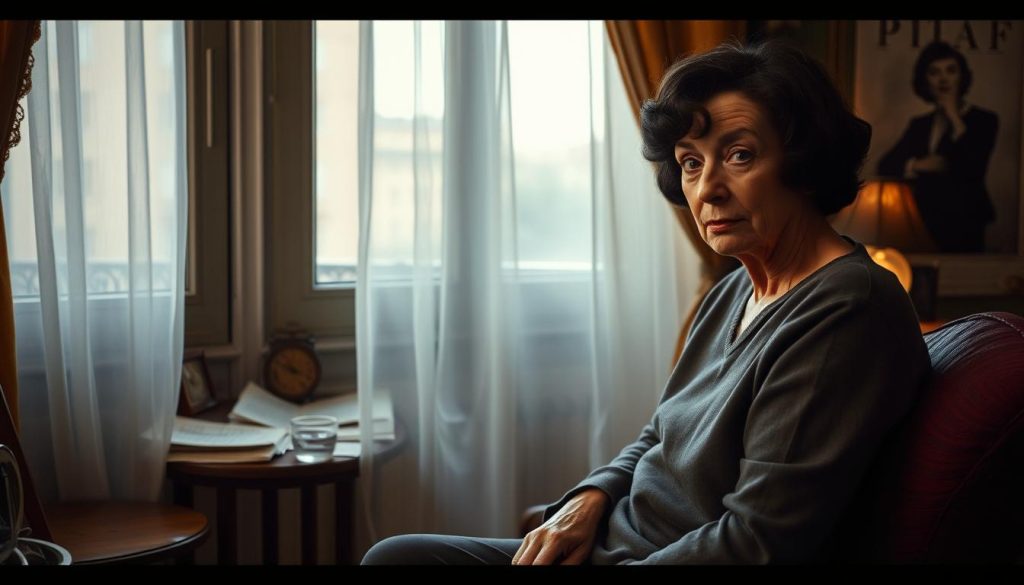
Édith Piaf, nicknamed “La Môme,” is one of the greatest icons of French song. Her unique voice and passionate performances left an indelible mark on music. Born in Paris on December 19, 1915, she transformed a life marked by poverty into moving art.
In this article, we explore the final moments of this iconic artist. Her declining health and the mysteries surrounding her death continue to fascinate her admirers. The clandestine transfer of her body to Paris has fueled many legends.
We examine the divide between historical fact and the myth surrounding her death. Archives and eyewitness accounts now make it possible to trace this period in detail. Despite her suffering, Piaf captured the essence of human emotion in her songs.
Introduction: a legend of French song nearing the end of her journey
Édith Piaf, an iconic figure in French song, captivated entire generations. Her remarkable career began in the cabarets of Pigalle, where she enchanted audiences with melodies that became timeless classics.
In the 1960s, despite her worldwide fame, the singer faced serious health problems. Her body, worn down by excess and hardship, contrasted with her public image as an icon. This contrast fascinated her admirers, who continued to show her unconditional love.
Her father, Louis Alphonse Gassion, passed on his passion for performing to her in childhood. That itinerant life shaped her character and determination. Édith Piaf also mentored many artists, including Yves Montand and Charles Aznavour, a testament to her lasting influence on music.
This article covers Piaf’s final moments, from medical realities to the story shaped by the media. Her legacy endures, and her love of music continues to inspire generations.
Brief biographical background before her final days
Born into poverty, Édith Piaf overcame a turbulent childhood to become an icon. Her journey began in difficult circumstances: her father was a contortionist and acrobat, and her mother was a street singer who struggled with alcoholism. They passed on a passion for performing to her.
Family origins and childhood
Édith Giovanna Gassion was born on December 19, 1915, at 4 Rue de la Chine. She grew up between her paternal grandmother, who ran a brothel, and her maternal grandmother, who was of Kabyle origin. This unsettled childhood shaped her character and her love of music.
One striking episode of her youth was a period of childhood blindness, said to have been miraculously cured after a pilgrimage to the grave of Saint Thérèse of Lisieux. The experience deepened her religious devotion.
She began singing in the streets with her father, then with Simone Berteaut, nicknamed “Momone.” These difficult beginnings in apartment courtyards and barracks helped her survive.
Career and success through the 1960s
Her career took off in 1935 thanks to Louis Leplée, who discovered her and gave her the nickname “La Môme Piaf.” Her early successes, such as “Les Mômes de la cloche,” marked the beginning of her fame.
Édith experienced tragic love affairs, including one with Louis Dupont, the father of her daughter Marcelle, who died at 28 months. Her greatest love, Marcel Cerdan, died in a plane crash in 1949, leaving an indelible mark on her life.
Health problems and dependencies
By the 1950s, her health was deteriorating. Édith suffered from rheumatoid arthritis, and her dependence on morphine and alcohol began to undermine her health. Archives document her many hospital stays, revealing that she was in poor health long before her final days.
Édith Piaf’s health in her final months
Édith Piaf endured health problems that marked the last months of her life. She was exhausted and burdened by repeated hospital stays. Worn down by excess, poverty and luxury, her body reflected her inner struggles.
Rheumatoid arthritis ravaged her body, causing unbearable joint pain. Demanding treatments had become routine, and the singer spent more time in clinics than on stage. A life punctuated by medical care contrasted sharply with the energy she had once displayed.
Her dependence on morphine, a direct consequence of car accidents, also played a crucial role in her decline. It haunted her until her final day. Alcohol, a problem also faced by her parents, added a destructive dimension to her life.
Her reported last words, “Everything you do in this life, you have to pay for,” echo a life marked by suffering. Her body, worn down by years of excess, smoking and lack of sleep, contrasted with the iconic image she had created.
Despite her condition, the public’s love for her did not fade. Those close to her tried to protect her from her own demons while continuing to celebrate her exceptional talent.
| Item | Details |
|---|---|
| Illness | Rheumatoid arthritis |
| Dependency | Morphine and alcohol |
| Time spent in hospital | More time in clinics than on stage |
| Last words | “Everything you do in this life, you have to pay for” |
| Overall condition | Body worn down by excess |
Choosing Plascassier: Les Parettes, her final refuge
Perched on a hill at an altitude of 300 meters, the country house known as Les Parettes offered Édith Piaf refuge. Located in Plascassier, between Grasse and Valbonne, it gave her respite from the bustle of Paris. Her decision to withdraw there reflected her search for inner peace.
The village of Plascassier, whose name means “muddy path” in Provençal, was an ideal setting for the singer. In this peaceful haven, she hoped to escape her suffering and turbulent past. Surrounded by greenery, the property was a true refuge for Édith.
Location and surroundings
Les Parettes was a peaceful place, with nature providing a soothing backdrop. Out of the public eye, Piaf could enjoy the beauty of Provence. The surrounding hills and fresh air contrasted sharply with the turmoil of her earlier life.
In this house, Édith Piaf could rest, listen to her songs and welcome a few close friends. Its simple, serene setting reminded her of her itinerant childhood, when she had learned to appreciate quiet moments.
Édith Piaf’s extended stay and the people who cared for her
During her final months, Édith Piaf was surrounded by a small circle of loyal companions. Her secretary and confidante, Danielle Bonel, had been by her side for decades. That steadfast presence brought her comfort and love in her darkest moments.
Simone Margantin, her nurse, watched over her fragile health. She witnessed Piaf’s final moments and provided essential medical support. Their conversations and the affection shared in the country house testify to Édith’s close bonds with those around her.
Choosing Plascassier, far from the spotlight, symbolized the singer’s search for peace. Exhausted by a life of touring, she hoped to find one final haven. Her father had taught her to seek refuge in simple places, away from show business.
| Item | Details |
|---|---|
| Name of the country house | Les Parettes |
| Location | Plascassier, between Grasse and Valbonne |
| Altitude | 300 meters |
| Companions | Danielle Bonel, Simone Margantin |
| State of mind | Seeking peace and respite |
The final moments: Édith Piaf’s actual death on October 10, 1963
At 1:10 p.m. that day, music lost one of its greatest voices. Édith Piaf, just 47 years old, breathed her last at Les Parettes in Plascassier. This peaceful place, far from the bustle of Paris, witnessed her final moments.
Her death was attributed to a ruptured aneurysm resulting from liver failure. The latter was a direct consequence of years of alcoholism and morphine treatment. The hours before her death were marked by a fierce struggle against an exhausted body.
At Édith’s side were her loyal friend and secretary, Danielle Bonel, and her nurse, Simone Margantin. Their unwavering support brought her some comfort in those difficult moments. These women shared her final hours, a testament to the love and friendship between them.
At that tragic moment, a legend passed away. The end of her life contrasted with the image of an indomitable artist.
“Everything you do in this life, you have to pay for”
echoes a life marked by suffering.
The singer’s body was prepared for a clandestine journey that would become part of the history of French song. Her death in October 1963 would remain etched in collective memory, even though the official account placed her death the following day in Paris.

Édith Piaf’s last days and the end of her life: the birth of a legend
Édith Piaf, an unforgettable icon of French song, met an end that was both tragic and romanticized. Her death gave rise to a complex account blending historical fact and myth. She actually died at 1:10 p.m. on October 10, 1963, at Les Parettes in Plascassier.
The story of her death did not end there. On October 11, she was declared dead for a second time in Paris, on Boulevard Lannes. This “double death” illustrates the control she had always wanted over her image. Piaf is even said to have declared:
“Dying in Paris is better for the legend…”
In her final days, the singer reflected on her legacy. She knew that the media and the public would tell and shape her story. The songs she left behind keep her memory alive. Each listen seems to bring La Môme back, as if her spirit still lingered in the Paris air.
The public’s fascination with this romanticized ending has made Édith Piaf much more than a singer. She has become an enduring icon, a legend who transcends time.
| Item | Details |
|---|---|
| Date of her actual death | October 10, 1963, in Plascassier |
| Date of her officially recorded death | October 11, 1963, in Paris |
| Reported final words | “Dying in Paris is better for the legend” |
| Impact of her songs | They come alive with every listen |
| Posthumous status | Enduring icon |

The clandestine transfer of her body to Paris
Édith Piaf’s body was transferred in secret, adding to the mysteries surrounding her death. During the night, it was transported without authorization so that the public would believe she had died in her hometown of Paris.
The mother superior of the Cannes-la-Bocca clinic played a crucial role in the operation. She lent an ambulance and provided a trusted driver for the delicate journey. The ambulance then made its way in secrecy to Édith’s Paris apartment on Boulevard Lannes.
The singer’s body was wrapped in tulle, with her mouth held closed by a Velpeau bandage. A trusted ambulance driver drove through the night, carrying her remains hundreds of kilometers to reach the boulevard early in the morning.
The secret transfer was intended to respect Édith Piaf’s final wish that the world believe she had died in Paris. Although the journey was clandestine, nobody reported the unauthorized transport of her body.
Boulevard Lannes, an elegant Paris address, became forever associated in the public imagination with the singer’s officially recorded death. This posthumous journey is one of the most dramatic episodes of Édith Piaf’s final days, worthy of a film script.
| Item | Details |
|---|---|
| Departure point | Cannes-la-Bocca clinic |
| Destination | Boulevard Lannes, Paris |
| Mother superior’s role | Lending the ambulance and providing a driver |
| Condition of the body | Wrapped in tulle, mouth held closed |
| Nature of the journey | Clandestine and unauthorized |
The false death certificate and the officially altered date
The day after Édith Piaf’s death, her doctor, Claude Bernay de Laval, made a controversial decision. He produced a false death certificate dated for the following day. The document stated that the singer had died at 7 a.m. on October 11 at her Paris home on Boulevard Lannes, rather than in Plascassier.
Bernay’s friendship with and loyalty to Piaf motivated this intervention. He agreed to change the date on the certificate to protect the artist’s image. In doing so, he sought to serve the legend surrounding her death. Although questionable, the act created a version of events that became the accepted account in the media at the time.
Dr. Claude Bernay de Laval’s involvement
Claude Bernay de Laval, Édith Piaf’s longtime doctor and friend, played a crucial role in the deception. Early on October 11, he signed the certificate, making official an account that did not match what had happened. The false document had significant legal implications, but the doctor was never prosecuted.
His action had lasting consequences for collective memory. For decades, the public believed the singer had died in Paris on October 11, 1963. The false account shaped perceptions of the end of her life.
Consequences for collective memory
When the certificate was signed on the morning of October 11, a new version of events emerged. It was accepted without challenge and became the official account. The trust between Claude Bernay and Édith Piaf helped make this possible.
Years later, the deception came to light, restoring the truth about Édith Piaf’s final days. The revelation brought the complexity of the artist’s life and death back into focus.
Reactions from loved ones and famous figures
The reactions of those close to Édith Piaf revealed the depth of their affection for her. Her death sent shock waves through the arts world and marked the end of an era. Among those most affected was Jean Cocteau, a close friend who had corresponded regularly with the singer.
Jean Cocteau and his death shortly after Piaf’s
Barely six hours after Édith Piaf’s death was announced, Jean Cocteau also died. On learning of his friend’s death, he reportedly said:
“It is the boat finally sinking. This is my last day on Earth.”
These poignant words convey the strength of their bond.
Cocteau also expressed his admiration for Piaf, saying:
“I have never known anyone less sparing with her soul. She did not spend it; she lavished it, throwing its gold out of the windows.”
His words speak to the artist’s generosity and intensity.
The steadfast presence of Danielle Bonel and Simone Margantin
Danielle Bonel, Édith Piaf’s secretary and confidante, had stood by her for decades. Her unwavering loyalty provided invaluable support until the singer’s final breath in Plascassier. Bonel saw Piaf as far more than an employer: she was a friend and a sister.
Simone Margantin, the nurse present at Piaf’s death, was also one of the few direct witnesses to the truth about the singer’s final days. Her account offers valuable insight into this difficult period.
The almost mystical bond between Jean Cocteau and Édith Piaf, together with Danielle Bonel’s loyalty, shows how art and friendship can intertwine at moments of great emotion. The memory of Marcel Cerdan, Piaf’s lost love, also hung over her life, adding another dimension to her legacy.
The media announcement and the making of a myth
Édith Piaf’s death sent shock waves through the arts and the media. The press seized on the event, publishing this sensational news on its front pages: “Édith Piaf died in her bed on Boulevard Lannes”. The headline quickly shaped the official myth surrounding her death.
Newspapers also circulated a troubling photograph of the embalmed singer. In it, a scarf surrounded her face and barely supported her chin. The image contributed to the artist’s tragic, romantic portrayal.
Simone Margantin, the nurse present during Piaf’s final moments, took part in shaping the media account. She told reporters that Piaf had been “lucid, cheerful and full of plans for songs” before she died. Her statement reinforced the image of an artist still full of life, even in the face of death.
Théo Sarapo, the singer’s young husband, also played a crucial role. He allowed the crowd into their apartment on Boulevard Lannes to pay their last respects. The gesture enabled thousands of admirers to honor their idol.
Embalming Piaf, a common practice, preserved her body for the days of public mourning that followed. Press archives from the period show how the media helped forge the legend of the artist’s final moments.
The newspaper headlines left their mark on the public imagination, forever linking Boulevard Lannes to the singer’s death. This media account persisted, leading people around the world to believe that Édith Piaf had died in Paris on that October day in 1963.
Organizing a funeral on a nearly national scale
On October 14, 1963, Paris came to a standstill to honor a legend of French song. Édith Piaf’s funeral drew an extraordinary public response, bringing half a million people into the streets. That day, the city was filled with shared memories and emotion.
The funeral procession and ceremony locations
The funeral procession left Édith Piaf’s home on Boulevard Lannes and made its way to Père-Lachaise Cemetery. The solemn route gave admirers a chance to pay their final respects. Thousands of people filled the streets, showing the singer’s impact on the world of music.
The absence of a religious ceremony and the issues surrounding it
Despite the scale of the event, the Catholic Church refused Piaf a religious funeral. The refusal was attributed to her turbulent love life and her status as a divorcée. The decision raised questions about the standards of the time and how society viewed the life of an independent artist.
Father Thouvenin de Villaret, a chaplain to artists, nevertheless gave her a final blessing at the burial in a strictly personal capacity. Though private, the gesture offered a spiritual connection with the singer and underscored the complexity of her legacy.
Édith Piaf was laid to rest before a grieving public. The atmosphere, both solemn and frenzied, showed how deeply people loved her. That October day marked the end of an era and Édith Piaf’s definitive entry into legend.
The public’s tribute and Édith Piaf’s legacy
On October 14, 1963, Paris was swept up in the emotions of an immense crowd. Around 40,000 people gathered at Père-Lachaise Cemetery to pay their final respects to the singer. The city witnessed scenes of collective frenzy: admirers broke through security barriers, trampled flowers and climbed trees and mausoleums to catch a glimpse of their idol’s remains.
Among those present, Marlene Dietrich was appalled by the scene. Bruno Coquatrix, director of the Olympia, was jostled by the crowd and fell into the grave. The day left an indelible mark on people’s memories.
In a poignant gesture, the gravedigger placed several of Édith Piaf’s treasured possessions beside her coffin. They included a stuffed rabbit, a sailor’s beret and a green silk tie. These keepsakes evoked her life and her love of the stage.
Another object was a statuette of Saint Thérèse of Lisieux, a testament to the deep faith rooted in her childhood. A legionnaire’s shoulder strap recalled her famous song Mon légionnaire. There was also a postcard from Milly-la-Forêt, inscribed by her friend Jean Cocteau.
Édith Piaf’s musical legacy endures. Her songs continue to move people around the world, retaining their power through the years. The archives preserve the memory of that extraordinary day, when La Môme became immortal in the hearts of her admirers.
Books, films and biographies continue to keep the artist’s story alive. Her love of music and her reputation as France’s greatest singer still resonate today. This legacy shows her lasting impact on music.
| Item | Details |
|---|---|
| Number of people present | 40,000 |
| Notable attendees | Marlene Dietrich, Bruno Coquatrix |
| Treasured possessions | Stuffed rabbit, sailor’s beret, green silk tie |
| Other objects | Statuette of Saint Thérèse, legionnaire’s shoulder strap, postcard from Milly-la-Forêt |
| Musical impact | Songs that endure through the years |
Conclusion: Édith Piaf’s final flight, between truth and legend
The journey of a unique voice came to an end, but her legacy endures. Édith Piaf’s final days, blending truth and legend, have captivated generations. From Plascassier to Paris, no one spoke a word about the deception surrounding her death. Many still believe that Jean Cocteau and Piaf died on the same day.
Her reported last words, “Everything you do in this life, you have to pay for,” sound like the poignant testament of an artist who gave everything. Songs, books and archives keep La Môme alive, affirming her reputation as a legendary singer.
The public’s unconditional love for her adds to the myth that surrounds her. The final flight of the Sparrow of Paris marked an era, and her voice continues to resonate in the hearts of millions around the world.