
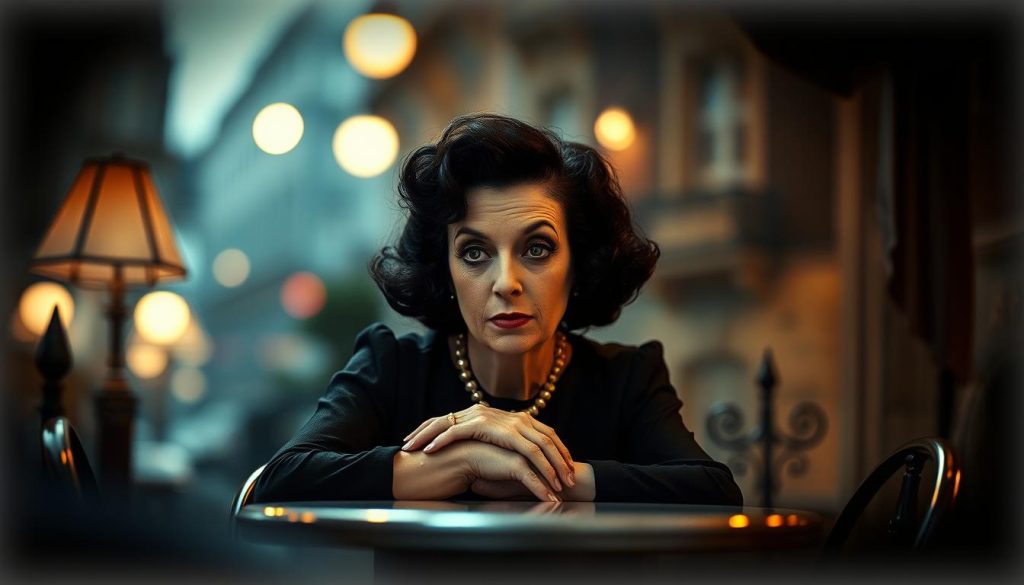
The age at which the famous singer died remains a subject of curiosity. Édith Piaf, born on December 19, 1915, in Paris, died on October 10, 1963, in Grasse, at the age of 47. Although official, this figure contrasts with the image of a woman whose life was marked by many excesses and tragedies.
October 10 is now recognized as the actual date of her death. For decades, however, many believed she had died on October 11 in her Paris apartment. This confusion adds to the legend of an artist whose life was shrouded in mystery.
Understanding how old she was when she died also means grasping the extent of the suffering that marked her life. This article traces her journey, from her difficult childhood to international fame, while examining the circumstances of her death and the impact of her passing on the music world.
Introduction: Understanding the age and circumstances of Édith Piaf’s death
The death of this icon left an enormous void in the music world. In October 1963, news of her death sent shock waves across France and far beyond its borders. Édith Piaf, the singer who embodied the soul of Paris, made a lasting impression on several generations.
Newspapers of the time, including the newspaper Sud Ouest, reported with emotion the passing of the woman affectionately nicknamed “La Môme Piaf.” The official account said she had died on the morning of October 11, 1963, in her apartment at 67 Boulevard Lannes in Paris.
The reality, however, is more complex. Her entourage arranged a clandestine operation to preserve the artist’s image. To understand the exact circumstances of her death, we must look back at the last months of her life, when her health was declining and she was struggling with serious addictions.
This introduction lays the groundwork for a biographical investigation. We will explore her story, from her family origins to the most personal details of her death. Dying at 47 may seem young, but that age reflects the toll of a life lived at full speed.
We will see how the legend grew around this woman with an extraordinary voice. Édith Piaf’s death became a dramatic episode worthy of a film. The sources consulted for this article include historical archives and testimonies that help separate fact from fiction in the story of her life.
| Date | Event |
|---|---|
| October 10, 1963 | Announcement of Édith Piaf’s death |
| October 11, 1963 | Official date of her death |
| October 12, 1963 | Sud Ouest headline: “La Môme Piaf Is Dead” |
Édith Piaf’s family and origins
Édith Giovanna Gassion was born into a world where art and poverty were closely intertwined. Her parents, both performers, shaped her destiny from her earliest days. Her father, Louis Alphonse Gassion, was a talented acrobat, while her mother, Annetta Giovanna Maillard, known as Line Marsa, was a singer. This artistic environment had an important influence on the future icon’s life.
Her family and artistic roots
Édith Piaf’s roots lay deep in the world of entertainment. Her father, nicknamed “the man who walks upside down,” was a well-known circus contortionist. Her mother, though gifted with an exceptional voice, struggled with alcoholism, which affected her daughter’s life.
Édith’s maternal grandmother, Emma Saïd Ben Mohamed, who was of Kabyle origin, and her grandfather, Auguste Eugène Maillard, also contributed to her cultural heritage. On her father’s side, her grandmother, Léontine Louise Descamps, ran a brothel, adding another layer of complexity to her childhood.
The municipal archives of Sens hold her parents’ marriage certificate, from their wedding in 1914, during the First World War. This historical setting shaped Édith’s life; her first name honors Edith Cavell, a resistance heroine.
Social surroundings and early family life
Édith Piaf grew up in severe poverty. Her mother’s addiction and her father’s frequent absences marked her early years. She was raised by her maternal grandmother in Belleville, a working-class neighborhood of Paris. This difficult childhood helped shape her character and her love of music.
According to a family legend, Édith was born on the steps of a building, reinforcing the myth of a child who rose from the streets. This romantic tale fits into a turbulent life in which hardship and art existed side by side.
Édith’s artistic origins reached back two generations: her grandparents and parents had all been involved in circuses and cabarets. This performance heritage undoubtedly influenced her later career.
| Relationship | Name | Role |
|---|---|---|
| Father | Louis Alphonse Gassion | Acrobat |
| Mother | Annetta Giovanna Maillard | Cabaret singer |
| Maternal grandmother | Emma Saïd Ben Mohamed | Of Kabyle origin |
| Maternal grandfather | Auguste Eugène Maillard | Performer |
| Paternal grandmother | Léontine Louise Descamps | Ran a brothel |
The difficult childhood and youth of “La Môme Piaf”
Édith Piaf’s early years were marked by constant instability. From a very young age, she faced serious family difficulties. At the age of two, Édith was placed in the care of her maternal grandmother, Emma, who lived at 91 Rue Rébeval in Paris’s 19th arrondissement. This period was particularly hard for the little girl.
Emma, often described as an alcoholic, let her live in unacceptably filthy conditions. Some rumors even claimed that her baby bottles were diluted with red wine. This lack of care and hygiene had a profound effect on her development. At 18 months, she was sent to live with her paternal grandmother, Louise, in Bernay. Although Louise ran a brothel, Édith was cherished by the sex workers there and finally received love and attention.
A defining event in her childhood came when she lost her sight because of keratitis in both eyes. This ordeal was followed by a miraculous recovery after a pilgrimage to the tomb of Thérèse of Lisieux in August 1921. The experience strengthened her faith and devotion to the saint, which remained with her throughout her life.
In 1922, when she was seven, her father, Louis Gassion, took her back and brought her into a nomadic life. Together they traveled the roads of France, living in caravans and performing in garrison towns such as Mourmelon-le-Grand. Circus life was harsh. Louis was seldom gentle, was quick to use his hands, and had relationships with various mistresses, all of which affected Édith’s daily life.
By the age of nine, she had begun singing in the street after her father’s acrobatic acts. She performed under the stage name “Miss Édith, vocal phenomenon.” Legend has it that she sang La Marseillaise, but it is more likely that she was already singing popular hits. This childhood, marked by poverty and a lack of parental love, shaped her character and fed the emotional intensity that became her hallmark on stage.
Édith Piaf’s early career in the streets and cabarets
Édith Piaf’s beginnings as a performer, in the streets and cabarets, reveal an early passion for music. In 1930, at just fifteen, she left her father to pursue a career as a street singer. Édith sang with her friend Simone Berteaut, nicknamed “Momone.” Together, they worked the courtyards and streets of Paris.
Momone collected money while Édith drew passersby with her powerful voice. They performed waltzes, tangos and javas, winning the admiration of onlookers. This period of her life was marked by great determination and a burning desire to make a name for herself.
Her first steps as a street performer
In 1932, Édith met her first great love, Louis Dupont, nicknamed P’tit Louis. Their intense relationship brought them a daughter, Marcelle, born on February 11, 1933. Despite the difficulties of motherhood, Édith continued singing in the streets, sometimes taking her baby with her.
Tragedy, however, cast a shadow over the young mother’s life. Marcelle died of tuberculous meningitis on July 7, 1935, at just 28 months old. The loss devastated Édith, but did not stop her from pursuing her passion for music.
The pivotal encounters and the nickname “La Môme Piaf”
Meeting Louis Leplée in the autumn of 1935 changed the course of her life. The manager of Le Gerny’s cabaret on the Champs-Élysées gave her the nickname “la môme Piaf” because of her small stature and slight figure. It was a turning point in her career.
Louis Leplée became her mentor, introduced her to the cabaret world and helped her meet influential artists. In 1936, Édith recorded her first record, Les Mômes de la cloche, for Polydor. Its success marked the beginning of her fame and introduced her extraordinary voice to a wider audience.
Archives from the time document this transformation and show how the street singer became a respected performer. Her journey was shaped by encounters that formed her artistic identity.
| Year | Event |
|---|---|
| 1930 | Beginning of her street-singing career with Momone |
| 1932 | Meeting Louis Dupont; birth of Marcelle |
| 1935 | Tragedy: Marcelle’s death |
| 1935 | Meeting Louis Leplée |
| 1936 | Recording of her first record |
Personal life, health and effects on her career
The singer’s personal life had its highs and lows. Édith Piaf endured hardships that shaped both her life and her art. Her intense romantic relationships often inspired her songs, creating a deep connection between her life and her music.
Piaf’s addictions and illnesses
Throughout her life, Édith Piaf suffered from various health problems. Her arthritis, worsened by alcoholism, caused chronic pain. Her dependence on morphine also had devastating effects on her body. These health problems limited her mobility on stage and made her final years particularly difficult.
Romantic relationships and tragic events
Édith Piaf’s turbulent love affairs marked her life. Her best-known relationship was with the boxer Marcel Cerdan. Their passionate romance ended abruptly when Cerdan died in a plane crash in 1949. Devastated, Édith composed iconic songs such as Hymne à l’amour and Mon Dieu, which express her immense grief.
She was also godmother to Cerdan’s son Paul and remained close to his family. Marcel’s widow, Marinette Cerdan, said:
“We are losing a great friend, a great sister.”
Édith Piaf married twice. Her first marriage, to Jacques Pills, took place in 1952; they divorced five years later. Her second, to Théo Sarapo, a young singer twenty years her junior, took place in 1962. He remained by her side until the end of her life.
The final years of her career were marked by canceled concerts and infrequent public appearances. Even so, her audience remained loyal. Her last concert took place in Lille in March 1963, a poignant moment that marked the end of an era.
| Event | Date |
|---|---|
| Death of Marcel Cerdan | October 28, 1949 |
| Marriage to Jacques Pills | 1952 |
| Divorce from Jacques Pills | 1957 |
| Marriage to Théo Sarapo | 1962 |
| Last concert | March 1963 |
How old was Édith Piaf when she died? A closer look
The final days of this musical icon still raise many questions. Édith Piaf died at the age of 47 on October 10, 1963. Her age speaks to the brevity of a life consumed by passion and excess.
More precisely, she died at 1:10 p.m. in Plascassier, a small village in the Alpes-Maritimes about 800 kilometers from Paris. For a long time, however, the public believed she had died on October 11, 1963, in her apartment on Boulevard Lannes, in the 16th arrondissement.
This confusion persisted for decades. In reality, Édith Piaf had drawn her last breath the previous day. Her entourage arranged the deception to preserve the artist’s legend. It seemed unthinkable that she might die anywhere other than the city she loved.
The official death certificate was dated October 11, 1963, by Dr. Bernay de Laval. This doctor, who was in on the deception, supplied the false document to support the version given to the media at the time: that she had died in Paris. The apartment at 67 Boulevard Lannes was presented as the official place of death, though her body had been secretly transported from the south of France.
Although entirely illegal, the deception was accepted by the authorities and the media. Many years passed before the truth about the exact circumstances of Édith Piaf’s death became widely known. The lasting confusion shows the power of the myth that surrounded the singer even during her lifetime.
Even today, many documents and biographies still give October 11, 1963, as the date of her death, unwittingly perpetuating a fiction that has become part of Édith Piaf’s legend.
| Date | Event |
|---|---|
| October 10, 1963 | Édith Piaf dies in Plascassier |
| October 11, 1963 | Official date of her death in Paris |
| 1963 | Death certificate dated October 11 |
The precise circumstances of Édith Piaf’s death
On October 10, 1963, Édith Piaf died at the age of 47. Her death, at 1:10 p.m., came amid tragic circumstances. She passed away in a country house in Plascassier, a small village in the Alpes-Maritimes, far from the bustle of Paris that had always surrounded her life.
This place, far from the capital, became the setting for her final moments. Years of dependence on alcohol and morphine had seriously damaged the singer’s body. These substances had profoundly impaired her health, worsening conditions she already had.
The actual place of death: Plascassier, not Paris
Contrary to popular belief, Édith Piaf did not die in Paris. Her husband, Théo Sarapo, was in Paris when she died. He did not arrive in Plascassier until 5 p.m., when he found her body with her nurse, Simone Margantin, and her secretary, Danielle Bonel.
The circumstances of her death were carefully concealed. Dr. Claude Bernay de Laval, Piaf’s personal physician, played a key role by providing a false death certificate dated October 11, 1963. The maneuver was intended to preserve the artist’s image by making people believe she had died in Paris.
The role of a ruptured aneurysm and her addictions
The specific medical cause of Édith Piaf’s death was a ruptured aneurysm. This tragic event was aggravated by a life marked by excess. Alcohol, morphine and other substances weakened her cardiovascular system, contributing to her premature death.
At the time of her death, she was also suffering from a severe liver condition, a direct consequence of her chronic alcoholism and arthritis. Piaf’s reported last words, “I would like to sing again,” speak to her passion for music even as death approached.
Her entourage decided to secretly transfer her body from Plascassier to Paris, convinced that it was unthinkable for an icon of French song to die anywhere but the capital. The secret was carefully kept for years, deepening the mystery surrounding her life and death.
| Date | Event |
|---|---|
| October 10, 1963 | Édith Piaf dies in Plascassier |
| 1:10 p.m. | Time of death |
| 5:00 p.m. | Théo Sarapo arrives in Plascassier |
| October 11, 1963 | Date given on the false death certificate |
The secret transfer of her body and the false death certificate
Secrecy and mystery surround the transfer of Édith Piaf’s body. Seven hours after her death, her body was discreetly placed in an ambulance. The hurried transfer remains one of the most extraordinary episodes in the history of French song.
To deceive the police during the 800-kilometer journey to Paris, her body was wrapped in tulle. Her mouth was kept closed with a Velpeau bandage, and a fake intravenous drip was put in place. The staging was meant to make it appear that the singer was still alive.
The clandestine operation and reasons for the transfer to Paris
Théo Sarapo, the singer’s husband, played a decisive role in the operation. He wanted to fulfill what he presented as his wife’s final wish: to die in her adopted city. Nurse Simone Margantin and secretary Danielle Bonel were central to organizing the secret transfer, attending to every detail so that it went smoothly.
The improvised funeral convoy arrived in Paris at daybreak. Édith Piaf was placed in her bed at 67 Boulevard Lannes, in the 16th arrondissement, as though she had died peacefully in her sleep on the morning of October 11, 1963.
The implications of the false certificate dated October 11
Dr. Claude Bernay de Laval, the final participant in the deception, agreed to provide a false death certificate dated October 11. The media and authorities of the time accepted the document as official. It named 67 Boulevard Lannes as the official place of death, erasing any trace of the singer’s final moments in Plascassier.
The false certificate had considerable consequences. It preserved the Parisian legend of Édith Piaf, but it also constituted a serious violation of French law governing death declarations. Although morally questionable, the clandestine operation shows her entourage’s absolute devotion to the singer.
Reactions, tributes and media impact of her death
News of this musical legend’s death deeply moved the public and fellow artists. On October 14, 1963, half a million people crowded the streets of Paris to accompany the funeral procession, which officially departed from 67 Boulevard Lannes, in the 16th arrondissement, and traveled to Père Lachaise Cemetery.
The crowd was so dense that police barriers gave way under the pressure. About 40,000 people poured into the cemetery, trampling flowers and climbing onto mausoleums in scenes of collective hysteria that left a lasting impression. Bruno Coquatrix, director of the Olympia, was jostled by the mourners and even fell into the grave where Piaf’s coffin was about to be lowered.
Many prominent figures from the arts attended the funeral. They included Marlene Dietrich, Gilbert Bécaud, Tino Rossi, Charles Aznavour and Yves Montand, who said:
“It is a terrible loss for French song.”
The Catholic Church, however, refused Piaf a religious funeral because of her turbulent romantic life. The decision caused controversy and added another contentious dimension to the event.
The reaction of the crowd and fellow artists
Édith Piaf’s death sent shock waves through the cultural world. Newspaper archives from the period, including those of Sud Ouest, attest to the enormous emotion prompted by her passing. Artists, friends and admirers came together to mourn the loss of an icon.
The mourning and death of Jean Cocteau
Another tragic event marked this period: the death of Jean Cocteau. On hearing the news on October 11, 1963, he said:
“It is the ship finally sinking.”
He died at 1:30 p.m. in his home in Milly-la-Forêt, aged 74. This double loss struck the world of French culture and left an enormous void.
| Date | Event |
|---|---|
| October 14, 1963 | Édith Piaf’s funeral procession |
| October 11, 1963 | Death of Jean Cocteau |
| 1963 | Crowds gather at the cemetery |
Édith Piaf’s musical and cultural legacy in France and around the world
Édith Piaf’s music spans generations and has left an indelible mark on music lovers’ hearts. Her musical legacy is vast and timeless. Songs such as La Vie en rose, Non, je ne regrette rien, Hymne à l’amour, La Foule and Milord continue to be heard and performed around the world, decades after her death.
Written in 1946, La Vie en rose is perhaps the best-known French song internationally. It is a celebration of love and life, translated into many languages and covered by hundreds of artists of all nationalities.
Édith Piaf’s influence on French song is immeasurable. She mentored exceptional talents such as Yves Montand, Charles Aznavour, Les Compagnons de la chanson, Georges Moustaki and Charles Dumont, and helped bring them to public attention. All acknowledged their debt to her.
The singer established a unique performance style, characterized by moving emotional intensity and perfect diction. That style profoundly influenced generations of artists and continues to inspire contemporary singers.
Her grave at Père Lachaise Cemetery has become a place of pilgrimage for admirers from around the world. Every year, fans come to pay their respects and leave flowers in tribute to a woman who remains one of the greatest voices in French music.
The treasured objects placed on her grave tell the story of her life in their own way. They include a stuffed rabbit, a sailor’s beret, a legionnaire’s shoulder board, a green silk tie, a statuette of Saint Thérèse of Lisieux and a postcard signed by Jean Cocteau.
The legend of Édith Piaf grew over the years, fed by the mystery surrounding her death, the power of her performances and the dramatic nature of her life. She is much more than a singer: she has become a timeless cultural icon.
The public’s love for Édith Piaf has never faded. Every year, commemorative ceremonies celebrate her memory and keep alive the story of this exceptional artist, who left a permanent mark on music history.
The singer’s tumultuous funeral and the immense crowd that attended it show the unique place she held in French hearts. She continues to hold that place in the collective memory nearly sixty years after her death.
The illness and suffering that marked the end of her life have done nothing to diminish the power of her legacy. Édith Piaf remains a touchstone for everyone who loves French song and the art of performance.
Conclusion
The final days of an iconic artist like Piaf still prompt reflection. The singer died at the age of 47 on October 10, 1963, in her country house in Plascassier, far from the Parisian bustle that had shaped her life.
The long-standing story that she died on October 11 shows the power of the myth that already surrounded the artist. Her life was a whirlwind of emotions, passionate romances and artistic triumphs, lived with an intensity that perhaps explains the premature toll on her body.
Despite the suffering of her final years, Édith Piaf never stopped loving her work. Her reported last words, “I would like to sing again,” resonate like an artistic testament. Her musical legacy, including songs such as La Vie en rose and Hymne à l’amour, continues to touch millions of listeners.
Historical archives and accounts from those close to her now allow us to honor the woman behind the legend. The immense crowd at her funeral in Père Lachaise Cemetery shows the unique place she held in French hearts.
Ultimately, answering how old she was when she died helps us better understand her life and work. Édith Piaf is gone, but her spirit and songs live on, proving that true legends never really die.