
Welcome to this article presenting a clear list of seven essential tunes to play in the game. We explain where each song is learned and what practical effects it produces.
Hyrule is a musical training ground. Players repeat short sequences to open passages, call mounts, or change the day/night cycle. Exploration, puzzles, and progression come together to create a memorable gaming experience.
We will also cover the warp songs taught by Sheik to complete your mental map of Hyrule. We will highlight the themes’ cultural influence, including references to other games in the series.
In practice: you will see how these tunes speed up travel, unlock access, and control the day/night cycle. We will offer tips for playing them on a real ocarina and a strategy for progressing through the game.
Finally, the conclusion will summarize each song’s main use so you can make the most of your playthroughs and remember everything on your next visit to Hyrule.
Why these seven melodies left their mark on the game and its players
The game puts music front and center, turning short sequences of notes into tangible actions. This choice placed the instrument at the heart of the experience and left a lasting impression on players.
Background: the ocarina at the center of a beloved game
When it was released, the game made learning notes one by one part of play. Early on, players learn simple patterns to open the Door of Time or call a mount.
Goals: learning, warping, and solving puzzles
You therefore need to remember short, easy-to-repeat sequences, each tied to a clear goal.
“Zelda’s Lullaby, associated with the royal family and Princess Zelda, shows the connection between storytelling and music.”
- Learning effect: gradual memorization.
- Practical role: travel, access, and the day/night cycle.
- Legacy: motifs reused or reversed in later games.
Seven Zelda: Ocarina of Time melodies to play on the ocarina
Each song played in Hyrule connects a place to a specific action.
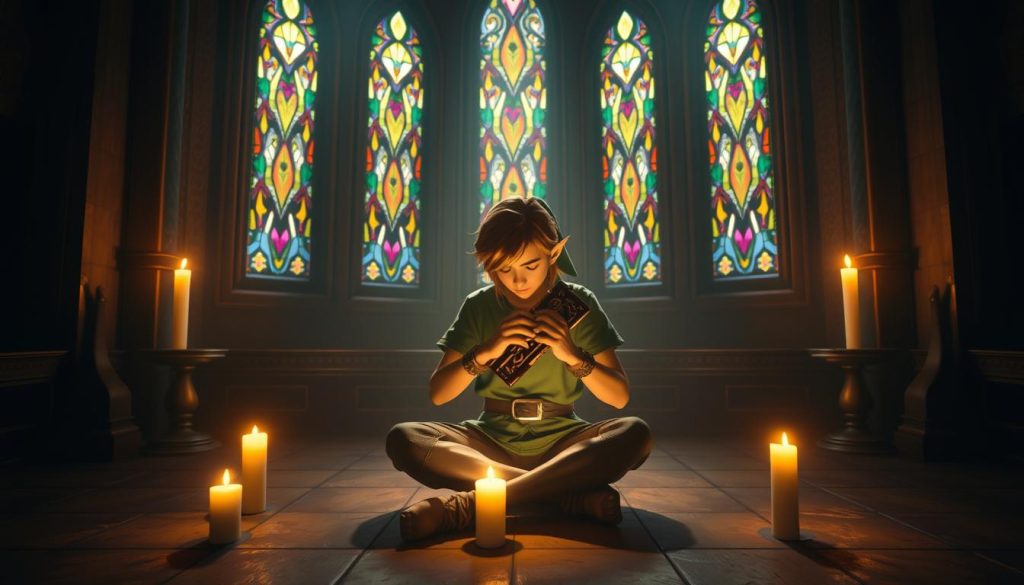
Zelda’s Lullaby — learned from Impa at the castle. It opens passages marked with the Triforce and helps you reach Goron City and Zora’s Domain.
Epona’s Song — taught by Malon at Lon Lon Ranch. It calls Epona to speed up travel and lets you get milk from a cow.
Saria’s Song — learned in the Sacred Forest Meadow. This telepathic link lets you speak to Saria through Navi and influence Darunia.
Sun’s Song — inscribed in the Royal Family’s Tomb in Kakariko Village Graveyard. It changes day to night, or vice versa, and freezes ReDeads.
| Song | Where it is learned | Function | When |
|---|---|---|---|
| Zelda’s Lullaby | Hyrule Castle | Opens passages marked with the Triforce (Goron/Zora) | Early game / castle visit |
| Epona & Saria | Lon Lon Ranch / Sacred Forest Meadow | Calls the mount, provides milk / enables telepathic communication | Middle of the first act |
| Sun & Time | Kakariko Village Graveyard / after the princess flees | Changes the day/night cycle / opens the temple door and moves blue blocks | Key quests, access to the temple |
| Storms & Scarecrow | Guru-Guru as an adult / a custom melody | Brings rain, reveals grottos, and grants access to the well; summons Pierre the scarecrow for the Hookshot | Exploration and shortcuts |
Memorization depends on linking a place with a function: remembering where you learn a melody helps you recall what it does during a quest.
Tip: try each song in marked or unusual areas. This often reveals secrets and speeds up progress in temples and elsewhere.
Zelda’s Lullaby: symbol, locations, and practical uses
The melody taught at the castle works like a musical key. Learned from Impa after meeting the princess, it identifies Link as an ally of the royal court.
Princess Zelda, the Triforce, and areas reserved for the royal family
Zelda’s Lullaby acts as a form of identification for the royal family. When a wall or altar bears the Triforce symbol, the melody often activates a mechanism.
“A simple motif is enough to open royal seals and reveal secret passages.”
Opening passages to Zora’s Domain and Goron areas
Specifically, playing the lullaby opens doors leading to Zora’s Domain and unlocks access in Goron areas. These openings are found mainly in places bearing a royal emblem.
| Where it is learned | Symbol | Use |
|---|---|---|
| Hyrule Castle | Triforce on walls and altars | Open doors to Zora’s Domain and Goron areas |
| Recognition by NPCs | Royal seals | Clue for temple puzzles |
The theme is reversed in Skyward Sword, creating a musical link between eras. Keep this lullaby in mind: it often helps solve puzzles involving time and royal alliances.
Epona’s Song: when and where to learn it, and all its effects
Epona’s Song turns the ranch into a starting point for your journeys. Return to Lon Lon Ranch once Talon has come home and things with Malon have settled down to learn this song.

At first, this melody helps you bond with Epona. Once you have built that bond, you can call the horse wherever she can travel.
Practical tip: playing the song in front of a cow gives you milk. The milk helps you survive and manage supplies on long journeys.
The time saved is obvious: you avoid long walks and some dangers. Play the song several times around the ranch and in the fields to strengthen your bond with the horse.
- Limits: Epona cannot appear indoors or in areas that are too narrow.
- Legacy: the theme returns as a whistle in Twilight Princess.
Think of the ranch as a familiar place where you master the music of travel. Make this song part of your routine to travel more efficiently in the game.
Saria’s Song: from Kokiri Forest to the Sacred Forest Meadow
The song learned in the Sacred Forest Meadow serves as a guide through the Lost Woods.
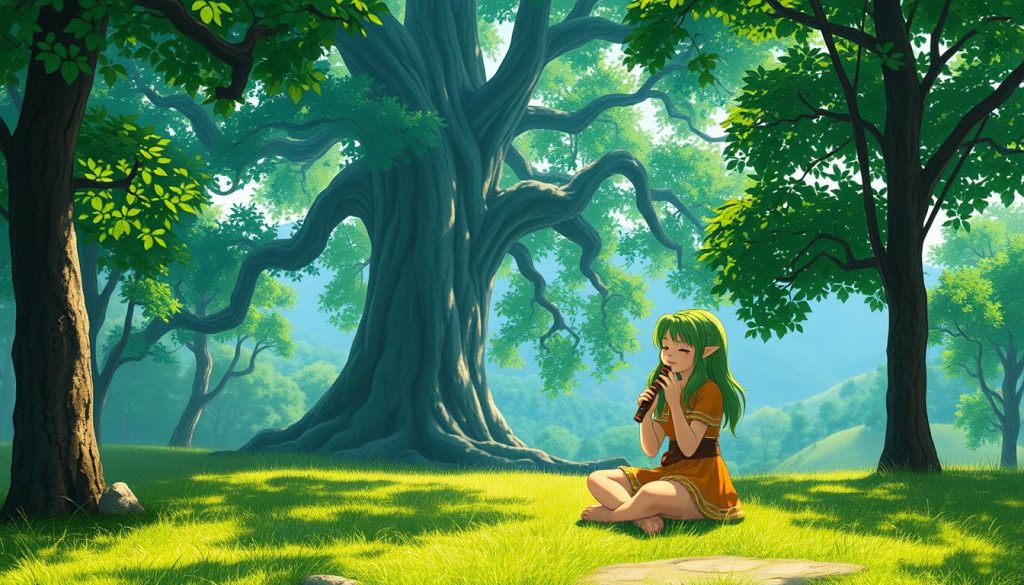
To get it, travel from Kokiri Forest toward the Lost Woods, then enter the Sacred Forest Meadow. There you will learn this melody, which will remain associated with the forest.
Communicating from afar, even seven years later
Saria’s Song creates a direct link through Navi. It lets you speak to Saria from any distance, even after the time jump.
Context and uses: this song can cheer up Darunia and convince Mido that the friendship is genuine. It also serves as an audible guide through the wooded maze.
“A song tied to childhood that guides and reassures.”
Keep this song ready: it comes into play at specific moments and enriches your mental sound map of Hyrule. To learn more about its history and functions, see the dedicated entry.
Sun’s Song, Song of Time, and Song of Storms: managing time and puzzles
Three tunes profoundly change how you approach puzzles and schedules in the game. They let you control the day/night cycle, open passages linked to time, and reveal hidden secrets in open areas.

Sun’s Song
Learned in the Royal Family’s Tomb in Kakariko Village, this song changes day to night or vice versa. It is valuable for quests available only at certain times.
This melody also freezes ReDeads, making dangerous areas safer to explore.
Song of Time
You receive this song after the vision in the Temple of Time, just after obtaining the ocarina. It opens the temple door and moves the blue blocks that alter routes.
In several dungeons, these blocks rearrange rooms and create new passages.
Song of Storms
Taught by Guru-Guru at the windmill when Link is an adult, the Song of Storms brings rain. It reveals grottos within rings of stones and unlocks access to the well in Kakariko Village.
Play the song among stones arranged in circles to find secrets and rare items.
- Strategy: treat time as a resource and change the cycle at the right moment to make travel and encounters more efficient.
- Memory aid: connect each song with a function — sun = schedules, time = doors and blocks, storms = rain and secrets.
The warp songs taught by Sheik
Some melodies offer a magical shortcut: they place Link right in front of a key temple. These tunes primarily let you warp to major locations, saving time as you move between dungeons.
Minuet of Forest
Learned in the Sacred Forest Meadow, it warps Link to the Forest Temple. It is useful for the Bow quest and for collecting keys quickly.
Bolero of Fire
Learned in Death Mountain Crater, it places Link near the Fire Temple. It saves you long journeys through the heat.
Serenade of Water
Learned in the Ice Cavern, it warps Link to Lake Hylia, just above the Water Temple.
Requiem of Spirit
Learned at the Desert Colossus, it lets you cross the sand and reach the Spirit Temple even as a child.
Nocturne of Shadow
Obtained in Kakariko Village after the encounter with Bongo Bongo, it takes Link back to the graveyard, the entrance to the Shadow Temple.
Prelude of Light
Learned at the Temple of Time, this prelude returns Link to the center of the world and makes traveling between objectives easier.
Tip: learn these tunes as soon as you can to warp to each location and travel more efficiently between objectives. For a complete list, see the song list.
A mental map of Hyrule: connecting each melody to its place
Visualizing Hyrule helps you associate each tune with where it is used. This connection cuts down the time you spend thinking during exploration.
Central locations and landmarks
Hyrule Castle = Zelda’s Lullaby. Use this landmark to remember royal access points.
The Temple of Time serves as a central point: the Prelude of Light brings Link back there.
Grouping by area
Kakariko Village is associated with Sun’s Song and the Nocturne of Shadow. These tunes control the time of day and open nearby areas.
The forest and Sacred Forest Meadow are associated with Saria and the Minuet of Forest. Think of green and woodland motifs.
The desert and the Colossus are associated with the Requiem of Spirit. Think of sand to remember this area.
“There are few exceptions: most tunes remain associated with their area.”
A practical method
- Build a mental “tower”: when you enter an area, check whether a song applies there.
- Use visual landmarks (Triforce symbols, stone tablets) to recall a tune.
- Adopt a color code: forest/green, desert/sand, volcano/red, lake/blue.
- Repeat the tunes as you pass through to strengthen the connection between place and melody.
| Location | Key tune | Function | Mental color |
|---|---|---|---|
| Hyrule Castle | Zelda’s Lullaby | Open royal access points | Gold |
| Kakariko Village | Sun’s Song / Nocturne | Change the time of day / reach the Shadow Temple | Yellow / gray |
| Sacred Forest Meadow (forest) | Minuet / Saria’s Song | Warp to the forest / find your way | Green |
| Desert Colossus | Requiem of Spirit | Access the desert, shortcut to the temple | Sand |
Tip: survey each new area like a small lookout tower and play its associated tune. Repetition strengthens your mental map and makes navigation feel more natural.
Resonances in other games: Twilight Princess, Skyward Sword, and beyond
Musical motifs carry across games and weave surprising connections between them. Their reuse highlights artistic continuity and sometimes supports the story.
The reversed lullaby in Skyward Sword
Skyward Sword reuses Zelda’s Lullaby in reverse. The result, called the Ballad of the Goddess, is a musical mirror that retains its signature while changing its emotional effect.
References in Twilight Princess
Twilight Princess reuses the whistle that calls the mount, a clear tribute to Epona’s Song. Fragments of the Prelude of Light also appear in key scenes.
Echoes in Majora’s Mask and Great Bay
Majora’s Mask revisits the theme of time by changing its tempo and harmony. Great Bay receives an exotic, bossa nova-like version that changes the area’s atmosphere.
- Common thread: music connects the story’s world with the game’s mechanics.
- Some arrangements of these recurring tunes recall Hyrule Castle.
- Listening to the soundtracks again reveals echoes, quotations, and variations.
Tips for playing these melodies on an ocarina at home
Practicing these tunes at home turns learning into a simple, satisfying ritual.
Start with simple patterns such as Zelda’s Lullaby and the Song of Time. Repeat them several times to master breath control and rhythm.
Active listening: listen to the original soundtracks and arrangements shared on wikis to grasp articulation and nuance before playing.
Use a slow metronome, then gradually increase the tempo. Adapt the fingering to your instrument: a 12-hole ocarina differs from a 6-hole model.
- Work on tuning sustained notes to produce a full tone.
- Transpose when necessary to preserve the shape of the melody.
- Hum the theme before playing to strengthen your aural memory.
- Organize practice sessions around “families” of tunes (forest, fire, water) to stay motivated.
| Goal | Method | Result |
|---|---|---|
| Rhythmic stability | Metronome: slow → fast | Breath control |
| Intonation | Long notes and recording | Full tone |
| Memory | Hum, then play | Precise note attacks |
Set small, playful goals, such as a miniature practice “dungeon”: play a warp song after a key song, then record yourself to correct mistakes.
Progression strategies: when to play each song during the game
Planning when to learn and use the tunes speeds up progress and avoids unnecessary backtracking.
Early game: access to the castle, the princess, and Zora’s Domain
Early in the game, prioritize the Lullaby learned at the castle. It quickly opens royal access points toward the Goron and Zora areas.
Next, learn Epona’s Song at the ranch to improve mobility. Saria’s Song is learned in the Sacred Forest Meadow and serves as a lasting guide.
Midgame: forest, fire, and water dungeons
In the middle of the game, learn Sheik’s tunes to warp to each temple: Minuet of Forest, Bolero of Fire, and Serenade of Water.
Use the Song of Time in dungeons to move blue blocks and create shortcuts. Combine warping with exploration to reduce backtracking.
Endgame: desert, shadow, light, and preparation for the final battle
Late in the game, use the Requiem of Spirit for the desert and the Nocturne for the shadow areas. The Prelude of Light makes it easier to return to the Temple of Time.
Before the final battle, check that you have learned all the useful melodies. Mobility and warping reduce the time needed to gather supplies and make preparing for battle easier.
| Stage | Priority songs | Main goal |
|---|---|---|
| Early game | Lullaby, Epona, Saria | Unlock royal access points, improve mobility, find landmarks |
| Midgame | Minuet, Bolero, Serenade, Song of Time | Reach temples, create shortcuts, save time |
| Endgame | Requiem, Nocturne, Prelude | Explore the desert and shadow areas, make return trips easier, prepare for the final battle |
“Adjust the order of your visits to suit your equipment and immediate needs.”
Conclusion
In short, these themes form a musical map that guides every exploration and encounter in the game. They shape the world’s progression and identity, from simply calling Epona to warping with Sheik’s songs.
In practical terms, these songs open doors, move blocks, control the day/night cycle, bring rain, and reveal secrets. They also help players prepare for the final battle by making return trips smoother.
The theme’s strength lies in its recurrence: these motifs appear in various forms in other games. To explore this further, read a musical analysis.
Apply the suggested strategies and associate a song with each key location on your mental map. Few game systems connect heart, mechanics, and story so closely; playing these tunes at home extends the experience and sharpens your ear.